Friday, September 27, 2013

Aloha Hawaii, MLK March Redux, Honduras RPCV, Interpretation Surprises, Baby Panda, Metro Doors, Dame from Spain, Zimmerman Again, Ted Cruz, Honduras Deportees, Pope Francis, Syria, Mugabe, Cholera in Cuba, Antúnez, New Cuban POCs


Whew! Please excuse my long delay between postings and everything but the kitchen sink posted here as a result. I was away visiting my kids, Stephanie and Jon, living in Honolulu, as per photos above, including of daughter Stephanie with her pet tortoise and her chameleon. The back yard of the house she owns with her husband is filled with abundant fruit trees: avocado, mango, orange, and papaya, a veritable Garden of Eden. The avocados are huge, round and sweet. My last visit there was 2 ½ years ago and it’s always a joy. Hawaii is an oasis in an otherwise difficult and violent world, but it’s cut off from everywhere else, which may be a blessing. The nearest land mass is California, almost 5 hours away by air. Hawaii is laid-back, beautiful, and has pretty good weather all year, oscillating between an average of 80 and 66 F in Jan. the coldest month, and between 89 and 75 F in August, the hottest month and it’s not humid, with ocean breezes always blowing. It does rain, especially in our winter months, but often at night, a heavy, quick, downpour. However, there are some wrinkles in Paradise, if that’s the right metaphor. Occasionally, there is a hurricane. At the beach near were Jon lives, there was no swimming because a cargo of molasses had spilled, killing flora and fauna. At Steph’s home, a wagon, pair of hiking boots, and bicycle pump my daughter and her husband left in their open carport was stolen while I was there. But it was wonderful seeing them again and worth enduring the lengthy plane trip, 3 different flights in all.

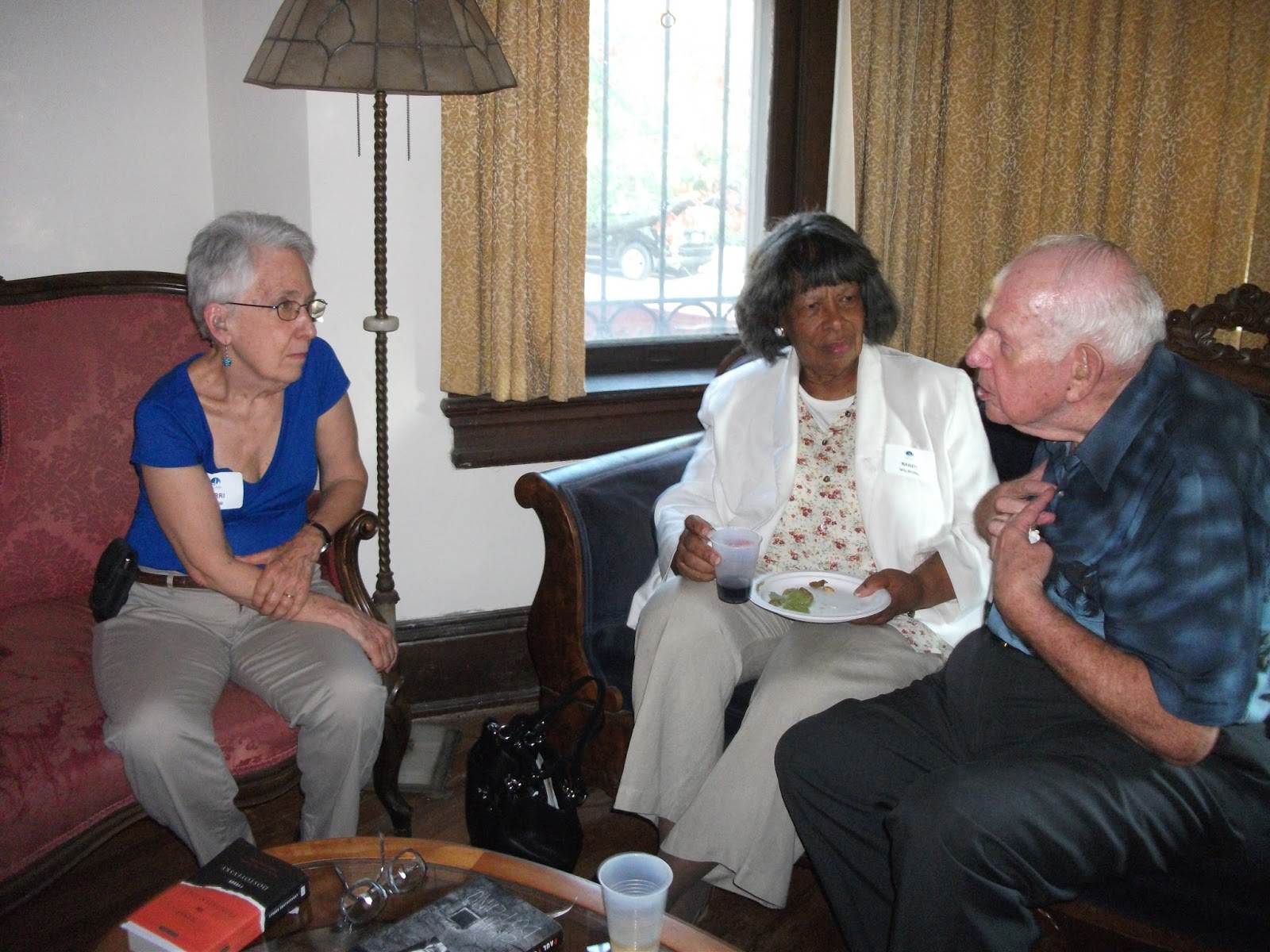
I was sent a photo taken of me and another woman who had been at ML King’s first march. The man who took it was showing it around his office when someone I know recognized me and gave him my e-mail address.

One of my fellow Honduras Peace Corps volunteers, Mitch, and his lovely Mexican wife, visited with their new baby (shown with me above).

A recent interpretation client from Peru, while getting ready for an MRI, asked me when I had first come to the U.S. and how long I had been living in this country, since I obviously knew English. I was totally flabbergasted, as I just assumed he knew I was a gringa. “Well,” I replied, both flattered and surprised, “I was born in this country and lived here most of my life, except a year in Central America as a toddler, two years in Colombia as a teenager, and then in Honduras with the Peace Corps in my sixties.” People have told me before that I don't have an accent in Spanish, but that kind of clinches it.

At a hospital, it happens sometimes that I am assigned as an interpreter for a Portuguese-, not Spanish-, speaking patient. Their names sound similar to Spanish names, they are from South America (i.e. Brazil), so it’s assumed that if they don’t know English, then they must speak Spanish. The two agencies I work for have Portuguese-speaking interpreters on-call, just as I’m on-call for Spanish. In any case, it happened again the other day, but that particular guy works in construction with Spanish-speakers and there are many similarities between Portuguese and Spanish, so we got along fine.

The baby giant panda born here at the National Zoo is female and, so far, so good, as she is still alive. Last year’s cub, also female, died, causing the mother panda to let out cries of distress and grief. As a female, this new cub may be allow to breed before being sent back to China, though I’m not sure that the Chinese government has dibs on all pandas born in perpetuity from those originally loaned to the US or whether our zoo can keep some of her offspring after sending her back. We had to send back her older brother when he turned 4. Her father is Tian Tian, also on loan to the National Zoo, whose breeding technique is faulty, so artificial insemination was used again. Apparently, when the female was fertile, he just pushed her face down and stood on her back. That was not effective. Just in case, semen from another male panda from the San Diego Zoo was also inserted, but Tian Tian’s won out according to a DNA test on the cub. She was born naked, but has since acquired hair, according to photos. She hasn’t yet made her public debut yet nor has she been named, since by Chinese custom, baby pandas aren’t named until they are 100 days old.

While coming back on the metro from a recent interpretation assignment, a man thrust his bag into the closing doors to keep them open while he tried to squeeze in, but the doors kept right on closing. Metro doors are not like elevator doors that open up again if someone comes between them. When the announcement is heard “Doors closing,” they keep right on closing without stopping. I suppose if it were otherwise, trains would be delayed. So this guy’s bag was barely inside the train and his hand was in the doors as they closed and the train started moving with his hand still stuck between the doors, dragging him along. We, the other passengers, tried to alert the driver in a front car far ahead, but fortunately, the man managed to pull his hand out and, though he stumbled, he didn’t fall off the platform. But his bag remained inside the train, partially stuck between the doors. At the next stop, I pulled the bag inside and another passenger with a cell phone looked through it for his number to call to tell him that we had his bag. Alas, his cell was in the bag, so no use calling. At a main intersection, Metro Center, the other passenger turned the bag into the office. It was quite scary when the man was being dragged by his hand and, I’m sure, he won’t ever try to force the doors open again. If he had an urgent appointment, he missed it.

Waiting for a flu shot at my local pharmacy, I sat next to a lady arguing vociferously on her cell phone with an insurance company and Medicare, demanding to be reimbursed for the cost of a blood pressure apparatus because her doctor had told her to take her blood pressure before taking a certain medication. I don’t know what finally happened with her efforts, but I also have moderate hypertension and have bought one of the monitors she was talking about from that same pharmacy for about $50, as I recall. It never occurred to me to try to bill health insurance. I do think small one-time expenses like that, even though health-related, should be born out-of-pocket by consumers and not passed on to insurance. Perhaps Medicaid for a low-income person could cover something like that if needed or could buy some in bulk and distribute them to needy recipients, but an ordinary consumer should be able to afford a OTC blood-pressure monitor and also a daily baby aspirin, even if a doctor has recommended them. Voters complain about burdensome taxes and the “nanny state,” so they need to show a little independence and bear some costs themselves, not take up the time of insurance company or Medicare staff to nickel-and-dime them.

A woman originally from South America, now resident in Spain, arrived recently at my house, but never felt comfortable sharing with other people. She was a real prima donna, used to living in a luxury home (photos of which she showed me)belonging to her much older lover, who apparently coddled her, a lovely place complete with swimming pool and flowered balconies. As soon as she arrived at my place, she took all the pictures off the wall in her room, feared the bed would collapse, did not want to share a bath although she had rejected the room with private bath as giving her “bad vibes,” and complained that sometimes her wireless connection failed (although I bought a booster). She didn’t speak English, so we all spoke to her in Spanish, even though that’s not the native language of any of the rest of us and we bent over backwards to show her all around the city. She soon found a place she liked better with a Spanish-speaking woman with a car (to whom she probably gave a terrible sob story about how much she had suffered at our house) and she left, much to my relief. I gladly refunded her share of our communal expenses. I’m just sorry that I turned away others because of her. In years of hosting international visitors, she’s the very first person to find my home intolerable. Different strokes for different folks. Her new hostess will soon find out that there’s no pleasing her. It’s interesting how some people have so little insight into their own behavior. She immediately rejected the room with wood floors and private bath, instead choosing one with wall-to-wall carpeting and shared bath, then began complaining about both those features and accusing me of misrepresenting my house to her. I had told her in advance that the house is 115 years old and in need of repairs and I tried to accommodate her wishes by giving her the room that met her specifications. This lady is 48 years old and purports to be a human right lawyer, but one who showed little concern for the human rights of other people living in the house. She had sent me in advance some photos shot of her by her boy friend in various “glam” poses, which were a red flag, but I had told myself not to judge her until I’d actually met her. By then it was too late. Now the house is wonderfully peaceful without her, indicative of the tension that the rest of us had endured while she was present. It’s always a risk to make such arrangements by long distance, kind of like on-line or blind dating, as when people actually meet face-to-face, they may or may not “click.”

So now George Zimmerman’s wife, after his acquittal of the murder of Trayvon Martin, is filing for divorce and has accusing him of threatening her and her father with a gun, though later failing to follow through on pressing charges. (She’s probably afraid that then he really would kill her.) Zimmerman also was arrested recently for driving under the influence, but released. It would appear that the guy is an impulsive hot-head who should never be allowed to carry a gun, but, I suppose, at the slightest move to take his guns away, the NRA and his other firearms’ supporters would rush in alarm to his defense.

Texas Senator Ted Cruz is certainly making a name for himself, but while some are touting him as a future presidential candidate, nary a word has been said about the fact that he was born in Canada. Nor was John McCain’s Panama birthplace ever an issue. But Barack Obama, who was actually born in the USA, has been continually subjected to rumors that he was born in Kenya—a place he never even visited until he was an adult. And there are some deluded souls who still believe he was born there. Such is the power of false advertising or wishful thinking by those who reject him as president. Meanwhile, the government shutdown that Cruz and his allies seem to desire is looming. Even if it averted at the last moment, considerable economic damage has already been done in preparing for it and in the country’s international reputation for solvency and good governance.

According to our local Spanish-language press, a record 28,000 Hondurans have already been deported so far in 2013. Pope Francis issued a statement on the Syrian conflict: There are so many conflicts in this world which cause me great suffering and worry, but in these days my heart is deeply wounded in particular by what is happening in Syria and anguished by the dramatic developments which are looming. I appeal strongly for peace, an appeal which arises from the deep within me. How much suffering, how much devastation, how much pain has the use of arms carried in its wake in that martyred country, especially among civilians and the unarmed! I think of many children will not see the light of the future! With utmost firmness I condemn the use of chemical weapons: I tell you that those terrible images from recent days are burned into my mind and heart. There is a judgment of God and of history upon our actions which are inescapable! Never has the use of violence brought peace in its wake. War begets war, violence begets violence.

With all my strength, I ask each party in this conflict to listen to the voice of their own conscience, not to close themselves in solely on their own interests, but rather to look at each other as brothers and decisively and courageously to follow the path of encounter and negotiation, and so overcome blind conflict. With similar vigour I exhort the international community to make every effort to promote clear proposals for peace in that country without further delay, a peace based on dialogue and negotiation, for the good of the entire Syrian people. May no effort be spared in guaranteeing humanitarian assistance to those wounded by this terrible conflict, in particular those forced to flee and the many refugees in nearby countries. May humanitarian workers, charged with the task of alleviating the sufferings of these people, be granted access so as to provide the necessary aid…All men and women of good will are bound by the task of pursuing peace. I make a forceful and urgent call to the entire Catholic Church, and also to every Christian of other confessions, as well as to followers of every religion and to those brothers and sisters who do not believe: peace is a good which overcomes every barrier, because it belongs all of humanity! I repeat forcefully: it is neither a culture of confrontation nor a culture of conflict which builds harmony within and between peoples, but rather a culture of encounter and a culture of dialogue; this is the only way to peace. May the plea for peace rise up and touch the heart of everyone so that they may lay down their weapons and be let themselves be led by the desire for peace.

Francis has also told the hierarchy to stop obsessing about gay marriage and abortion.

From the photos, I’m pretty sure that the mall at the center of the terrorist attack in Nairobi is one that I once visited, very large, modern, and upscale. I don’t think there are 2 malls of that fancy caliber in Nairobi. I was taken there to show it off to me when I was on my way to South Sudan in 2006.

Recent revelations of atrocities committed by some rebels last year certainly muddy the waters on intervention in the Syrian conflict. The internet has greatly increased the visibility of atrocities on both sides in this conflict. Maybe the Russian-backed proposal to have Syria destroy its chemical weapons will avoid the many problems stemming from an actual US attack.

How attitudes have changed in terms of civilian war casualties! During World War II, the US did not hesitate to firebomb and destroy Dresden, notwithstanding the presence of civilians. Even more egregious was the atomic bombing of not one, but two, Japanese cities with countless very cruel deaths and maiming of civilians. Fortunately, world opinion seems to have turned against the infliction of civilian casualties, though they continue to occur.

Nonagenarian Robert Mugabe, commenting recently on his latest supposed presidential victory, one of a whole string of suspect victories over the decades, said, “Those who can’t stomach the defeat, you can commit suicide.”

Cholera in Cuba - Advisory to Travellers Havana, Sept. 4.─ The Pan American Health Organization (PAHO) has issued a Report that may serve as a notice of prevention to travelers about a Cholera outbreak in Cuba. Cholera is one of the oldest reportable diseases along with the plague and yellow fever. Under the International Health Regulations (IHR), the regulatory arm of the World Health Organization (WHO), the rapid spread of cholera has a long history. Cuba's decaying infrastructure of poor water, sewage, sanitation and housing conditions coupled with heavy rains and international medical missions exporting medical doctors to other countries, makes cholera ripe for rapid spread not only in Cuba but in other countries having many tourists visiting the Island. Recent laboratory evidence confirmed that travelers carried more than their luggage home from Cuba. In the past two weeks, PAHO reported cases ailing tourist returning to Italy, Venezuela, Chile, Spain, Germany and the Netherlands. "Included in the confirmed cholera cases are 12 persons who had travelled to Cuba from other countries", the PAHO Report says. PAHO reports a spread of cholera in the provinces of Havana, Santiago and Camaguey and a total of 163 recently confirmed cases plus 417 reported in 2012. The U.S. Interests Section announced a cholera warning for Cuba on August 20, 2013. However, the Center for Disease Control and Prevention (CDC) of the United States, has not posted yet a notification about cholera in Cuba for the summer of 2013.

Since then, have heard of a few dengue cases in south Florida, probably brought by Caribbean visitors.

Two rafters trying to escape eastern Cuba drowned and six survivors were arrested by Cuban authorities.

Another recent Cuban human rights visitor to DC was Afro-Cuban activist Jorge Luis García Pérez, nicknamed Antúnez (shown with me above), who after refusing political “rehabilitation,” was finally released in 2007. (See photo of me with him above.) He has been arrested and beaten by the authorities numerous times since and has embarked on several hunger strikes to protest the deaths and mistreatment of other prisoners. While incarcerated, he wrote and smuggled out a book about prison conditions entitled Boitel Vive, a tribute to political prisoner Pedro Luis Boitel, who died following a hunger strike in 1972. He gave me a signed copy of his book. Antúnez contends that Afro-Cubans have suffered disproportionate repression in Cuba, filling up the jails and being unwelcome in the government’s inner circle, “A black president is impossible in Cuba because of not being a Castro.” He considers the Obama Administration too conciliatory toward the regime and proudly declares himself “not a dissident, but an opponent,” though always committed to employing peaceful means. And, while he is glad to have the chance to tell his story abroad, it’s not being heard inside Cuba, where it really counts.

As most readers know, I’ve been an Amnesty International volunteer activist for more than 30 years, the last 9 years serving as coordinator for the Caribbean. We at Amnesty have just named 6 new Cuban prisoners of conscience, that is, those who have neither advocated nor engaged in violence, incarcerated only for peaceful expression. Among them are three brothers, including teenage twins. One has been on a hunger strike since his arrest in late July, 40-year-old Afro-Cuban Iván Fernández, charged with “dangerousness,” a catch-all category used to arrest people before they actually commit a crime.

Saturday, August 31, 2013

Happy Holiday, Apologies, ML King Commemoration, Late Son’s Birthday, Honduras News, Egypt, Syria, Cuban Rafters, Panda Birth, Adoption Issues, Impeachment, Zapatistas

 
Happy Labor Day. Though not a Labor Day theme, I was intrigued by the decorated van parked across the street from my house, reminding me of decorated buses, some in Honduras and many in Haiti. The first time I tried, the bus didn't post, so we'll see on this second try. Looks like omitted photo will not post nor are there spaces between topics as a permanent feature. Will have to figure out what to do next time. Maybe this is to encourage shorter and more frequent posts? if anyone knows how to correct this, please advise here or at my e-mail address above.

Very sorry about run-on blog posting last time. It must have been a fluke that I certainly hope won’t be repeated. The failure to leave space between paragraphs and topics last time, even when I erased the whole thing and reposted it with double spaces between, may have been a one-time event. We shall soon see here. If extra space appears here now, it’s because of my exaggerated effort to separate topics. There is no one readily available that a blogger can call or write to at blogspot to find out about or fix a problem; that might take too much staff and cost money. I'm wondering this time whether at least indenting each new paragraph, if allowed, will help with readability. Will try it now.

Washington, DC, in the last several days, has been caught up in a commemoration of the 50th anniversary of MLKing’s “I Have A Dream” speech. Of course, as already mentioned, I attended the original 50 years ago with my then-husband. We had another reason for visiting the nation’s capital at the time, but had scheduled it so we could participate in the King march. Back then, I confess to not realizing that it would be such an historic event, though I do remember being very impressed at seeing so many people of all races, ages, and nationalities gathered together as far as the eye could see. The original was held on a bright sunny day, unlike the overcast sky and light rain of the anniversary event, with many, many more people and much less security. That is, 50 years ago, while there were lots of police and National Guard around the periphery of the crowd, in case we rioted, I guess, in contrast, this time, we all waited in a long line to be funneled through security gates and were wanded individually with metal detectors. Of course, back then, King was not that famous or well-known, while on the anniversary, we were hearing from the President live and two of his predecessors, Carter and Clinton. Although the air was humid and drizzly during the commemoration, it was fortunately not too hot. And this time, I could hear the main speeches much better, including Barack Obama’s, whereas King’s speech, though delivered with emotion and gestures, had been hard to hear from where we were standing 50 years ago. This time, bells chimed precisely at 3 pm, sending a thrill through the crowd, and, soon after, Obama began speaking and he spoke at length. Certainly, progress has been made over the last half century, though as Obama said, much still remains to be done to increase racial and economic equality and opportunity in the United States. Still, it was a memorable and hopeful day. A woman next to me fainted and was taken away in a wheelchair by people wearing red-cross insignias. I met several older folks who, like me, had been present 50 years earlier and we shared a special feeling of camaraderie. After the President finished speaking, there was a huge crush as everyone rushed for the exits.

September 4 is my late son Andrew’s birthday. He would have been 46. Of course, in my mind, he is always 27, the age at which he died.

For the first time recently, I had a translation of the medical records of a patient from Honduras, someone with an apparent history of kidney cancer—of course, I only have the written medical records to go on and a little data on the patient, like her birth date. These particular records would indicate that Hondurans who can afford private care get pretty sophisticated treatment, although, like those from other countries whose records I’ve translated, they apparently come to the US for the last word or a last ditch effort at finding a cure.

Here is statement from Afro-Honduran Garifuna people living on the north coast and depicted above marching for their land rights: We have occupied and claimed ancestral lands that had been taken by others, such as Vallecito Limón. We are also using international human rights law in order to guard our territories. We have a claim against the government in the Inter-American Court of Human Rights in Washington regarding Triunfo de la Cruz . We hope to have a decision in November or December. This will create an important precedent for all indigenous peoples, not just for the Garífuna. It’ll define the responsibility of the state to protect territories and rights of indigenous peoples. This will only be the [fourth] case ever brought that will help establish policies and mechanisms to protect the territories and resources of indigenous peoples, and all of humanity, of course. [The other three are] Sarayacu in Ecuador, Saramaca in Suriname, and Awas Tingni in Nicaragua.

Also in Honduras, the computer system for the newspaper La Gaceta was hacked and a message from “Anonymous” appeared: Recuerden gobiernos, recuerda Pepe Lobo, es el gobierno quien debe lealtad al pueblo y no al revés. La patria no se alquila, no se presta, no se vende; corruptos de Honduras, ya despertará el país, esperad lo. (Remember governments, remember [President] Pepe Lobo, it’s the government that owes loyalty to the people, not the reverse. The homeland cannot be rented out, not lent, not sold; corrupt citizens of Honduras, the country will wake up, be prepared.)

Egypt appears to be on the verge of or already in a civil war. The extent of the bloodshed is inexcusable—the army should not have used force to dislodge people camped out on the streets provided they were not attacking others, the police, or property. On the other hand, the Muslim Brotherhood, like many political factions who win elections in a previously autocratic nation, may have felt they were entitled to act like dictators because of the vote. Of course, in many other countries, winners take advantage of their position to further their reign and reward their cronies; even in the United States, winning candidates name their supporters to important positions and try to get themselves or their party members elected subsequently. Others, like the late Hugo Chavez and some of his Latin American allies, rig the system to be re-elected continually by changing laws, controlling media, and doling out favors. But even they have not gone as far as Egypt’s military, which seems to have used excess force and created martyrs and a severe political rift that will be hard to heal. Even Mubarak does not seem to have gone that far in such a short time. However, the US is keeping its options open on aid, perhaps to maintain some leverage and also to protect American arms manufacturers supplying Egypt, as well as Israel, which has a treaty with that country.

As for Syria, both inaction and action are risky. There are bad actors on both sides and war brings unintended consequences. The American public is war weary, but still an atrocity has been committed in violation of international law. Obama feels impelled to respond, but apparently doesn’t want to take the chance of being rebuffed by the Republican Congress using a vote as another effort to thwart him. He also has the example of the British Parliament preventing UK participation in any action. At the same time, there is the sorry example of GW Bush getting our nation into a protracted war under false pretenses. I’m glad I’m not the president having to decide in this case.

In an update on the Cuban rafters being held in immigration detention and mentioned last time, two are being considered for asylum in the US, one was being considered by a third country, and what happened to the asylum offer from Panama for 19 more is now unclear. If those two actually make it to the US, they've won the jackpot, and if another gets asylum elsewhere, he won't do so badly, but those who were returned to Cuba, 24 so far and 20 more pending, won't fare too well. It's really a matter of luck among rafters who survives, who gets to the US, and who is returned to Cuba, but even the limited success of this group of rafters will inspire others to try. However if they hadn't raised such a ruckus, they all would have been sent back by now. Gone are the days of Brothers-to-the-Rescue, a group of Cuban Americans who circled in small planes, picking up lost rafters. That effort ended after the Cuban military shot down two Brothers’ aircraft and after President Bill Clinton instructed the U. S. Coast Guard to send rafters back to Cuba. Otherwise, if the Brothers had been permitted to continue their rescues, South Florida would be even more inundated with Cubans than it is already.

The female giant panda at the National Zoo in DC has given birth to her 3rd cub. The first had to be sent back to China after 5 years. The second born last fall died. Panda cubs are very tiny and delicate at birth. A twin of this cub was still born. So we are all holding our breath for it this time. Gender is still uncertain.

Although I haven’t mentioned it much on this blog, I’m a board member of a local adoption agency, Holy Cross. In a recent conversation with the director, I learned that adoption has become increasingly difficult and expensive. Also, increasingly rare. Reproductive assistive technologies have increased, contraception is more reliable, and abortion is legal. Surrogacy is also in vogue. Foreign countries have also been tightening their rules or shutting out American adoptive parents (i.e. Russia, and India and China have new restrictions), the Hague Convention designed to regulate adoptions internationally has turned out to increase costs and slow the process with excessive paperwork, and the internet has allowed prospective adoptive parents to search on line to find birth mothers. More domestic adoptions being carried out privately rather than through agencies and money changes hands, though, strictly speaking, a birth parent cannot be paid for giving up a baby but she can have lots of expenses paid, such as rent, food, medical care, maybe even a car. Our agency’s director said that one of her best and least expensive contacts is with a lawyer in Florida who charges a flat $50,000, almost a bargain in today’s market. She also works with an organization in Georgia that specializes in African American babies often sought by black couples, but increasingly unavailable through agencies as well. Such a couple in DC, after getting a home study from the local public agency, was told that now DC is only placing children with relatives, so they will have had to look elsewhere. But after a child is actually in the new home, a home study is still required before an adoption can be finalized, which is where our agency comes in these days, after, not before, the fact of placement. Adoptive parents would really have to do something terrible or to reject the child for the adoption not to go through at that point. My director friend recently approved an adoption by a high profile African American single woman who expected to be adopting a biracial baby, but when the infant was actually born, he looked totally Caucasian—the white birth mother said she wasn’t sure of the father because of having had more than one partner, but had been guessing that the father was probably African American. Apparently, he was not the one after all. But the new adoptive mother is thrilled with her pale baby and turnabout is fair play for all the black and other non-white children adopted by Caucasian couples.

Two Republican congressmen and a senator say they want to impeach the President, though their reasons for doing so remain murky. Apparently, they just want him out of office, gone, disappeared, vanished, an idea that apparently plays well with their constituents during this recess campaign season. They are Rep. Blake Farenthold of Texas, Rep. Kerry Bentivolio of Michigan who looks a little like Dick Cheney in his photos, and Senator Tom Coburn of Oklahoma. Maybe others will jump on the bandwagon. Interestingly enough, Republicans who made such a big deal about Obama’s supposed Kenya birth and his consequent ineligibility for the presidency are being completely mum on the fact that Senator Ted Cruz was born in Canada, nor did they raise the birthright question for McCain, who was born in Panama.

This is not a current issue, but one that has some resonance in recent Mexican history, how the Zapatistas, led by horse-riding masked man Comandante Marcos AKA Delgado Zero (neither his real name), tried to co-op the indigenous people of the southern-most Chiapas region of Mexico to start a movement to overthrow the bourgeoisie and install a socialist government. He had read Marx and fought with the Sandinistas in Nicaragua. Patricia, a Mexican anthropology doctoral student staying with me until the end of the month, had promised to make a presentation on the Zapatistas to my local Amnesty International group, but was unexpectedly detained in New York City. So, I had to stand in for her as best I could. The Zapatistas’ involvement in Chiapas brought in the Mexican army and while local people did not welcome the army, during the ensuing conflict, they found their own voices and did not need the Zapatistas to represent them anymore. Marcos retreated to a secret place and continues his efforts at revolution in writing. European supporters mostly left after the recession. Some communities still consider themselves Zapatistas, but they do so under local leaders.

Wednesday, August 14, 2013

Honduran November Elections, Peace Corps Budget, Do-Nothingest Congress, Anti-gay Violence in Jamaica, Robert Mugabe, Cuban Rafters in Bahamas, Oswaldo Payá’s Spanish Driver on Fatal “Accident,” Hamilton Quilt, American Health Care

Again, last time, as the time before, the photo I wanted from my translators’ party failed to post. I guess blog.spot just doesn’t like that particular photo. Its size is something over 2 mg. but so are others that have posted successfully. OK, so I give up, cannot post it for whatever reason. If anyone can hazard a guess regarding the problem, please let me know via my e-mail address shown at the beginning of this blog. It’s quite puzzling as looks like a normal digital photo and has been e-mailed elsewhere, also posted on Facebook.

I tried making this post before, but it all ran together, no space between paragraphs or topics, and could not be corrected, so I tried to erase it all and decided to start over. This time, I'll even leave extra space. Perhaps too much. We'll see what happens. Even with leaving double space between topics, I see it still is running them together, so Blospot must be having a bad day. Sorry, folks!

In Honduras, President Porfirio Lobo is welcoming foreign election observers for the elections scheduled for November 24.

Not surprisingly, the House version of the Peace Corps budget contains 20% less funding than the Senate version, some $30 million less, which for the Peace Corps is a lot.

So far, the 113th Congress is the most unproductive in history. After nearly eight months, just 22 bills have passed and been sent to the President—worse than the famous “Do-Nothing Congress.” Even though the House of Representatives has worked for just 87 days this year, Speaker John Boehner just called for a five-week recess and left town to go golfing with Donald Trump.

An issue of concern to me as volunteer Caribbean coordinator for Amnesty International USA is the rampant anti-gay violence in Jamaica, where it has been reported that a 16-year-old youth, Dwayne Jones, was murdered apparently because he went to a party dressed as a woman (“In Jamaica, Transgender Teen Murdered by Mob, “ AP, August 11, 2013). This is just speculation on my part, but perhaps anti-gay violence now flares especially fiercely in countries where mores on homosexuality, influenced by changes in the US and Western Europe, are just starting to change there too—is Jamaica one these countries? This violence may be an expression of resistance to that impending change and a reaction in a cultural climate where gay and cross-dressing youths are now daring to more openly express what they had kept strictly hidden before.

Robert Mugabe, age 89, has again declared himself the winner of Zimbabwe’s presidential election. The guy is tenacious, I’ll grant him that, and I don’t disparage him simply because of his age as I’m no spring chicken myself. But after decades, how about giving someone else a chance, since, quite obviously, his rule has not been good for Zimbabwe?

In the Bahamas, 19 boat Cuban people held in immigration detention there, after alleging abuse and some sewing their mouths shut in protest, and after Cubans in Miami rose up to support them and threatening to boycott the Bahamas as a tourist destination, have been offered asylum in Panama, resolving the stand-off, although some other Cuban migrants remain, awaiting offers from other countries. Obviously, their intended destination was the United States, which did not step forward. However, if some make it through Mexico, they may yet arrive in this country.

Below is the headline of an article appearing in the Spanish-language version of The Huffington Post. It refers to an article saying that the driver of the car in which Cuban democracy activist Oswaldo Payá was killed was deliberately rammed from behind. The Spanish driver, Angel Carromero, in an interview with the newspaper El Mundo accuses Cuban State Security of murdering Paya. This is what Paya’s daughter Rosa Maria told us when she met with us at the DC office of Amnesty International. New UN Ambassador Samantha Power brought up the issue in a recent meeting with the Cuban foreign minister.

Ángel Carromero, entrevista en 'El Mundo': 'A Oswaldo Payá lo asesinaron' EL HUFFINGTON POST | August 4, 2013

On a visit to a friend in western Virginia, in the Blacksburg area where my parents used to live, I slept under a lovely, multicolored patchwork quilt, completely intact, every careful stitch visible. My friend said she is a descendent of Alexander Hamilton and has some quilts that were part of his estate. Imagine using a quilt lovingly hand-sewn by a woman living centuries ago. Thanks, lady, whoever and wherever you are.

Playing amateur psychologist here after seeing a woman on a bus treat her 2-year-old son with unnecessary roughness, yelling at him and yanking him to sit down beside her, “You get over here right now, or I’ll smack you, do you hear?” The child obeyed, then leaned up against the mother, hugging her, as if to reassure himself that she cared. I’ve seen children who have been scolded then seek love and reassurance from seemingly rejecting or hurtful mothers and wonder if a similar odd dynamic is in play sometimes with abused women who return to their abusers—wanting affection, but looking for it from someone close who blows hot and cold?

I just finished reading a provocative book, Catastrophic Care, How American Medicine Killed my Father—and How We Can Fix It, by David Goldhill. I won’t give you the whole story—read the book—rather just some highlights. The author’s elderly father entered the hospital with pneumonia, meanwhile acquired several hospital-borne infections, and died, one of 100,000 patients who die each year from hospital-acquired infections. The deceased’s widow received an astronomical hospital bill, which she ignored and no attempt was ever made to collect on it. Infections are not the only harm that emanates from the health care system itself, since unnecessary procedures and surgeries also inflict harm. And there has been a push by drug companies and other providers to “medicalize” conditions such as “erectile dysfunction,” obesity, and other conditions that used to be accepted as lifestyle choices, facts-of-life, or facts-of-aging, thereby to get them covered under the “heath insurance” umbrella. Advertising urges consumers to “ask your doctor” about a certain drug, apparatus, or procedure, thereby creating demand. No wonder “health care” is consuming an ever-increasing share of individual and public budgets, crowding out other social benefits that may also impact on health and well-being.

Since a fraction of patients use 70% of health care resources and since most people’s largest expenditures are made in the last months of life, in an often futile attempt to prolong their life, these are areas where remedies should be sought. But for the large bulk of worried well who have a steady income, author Goldhill suggests putting savings aside for a rainy day of health expenditures, which patients would then finance on their own and would shop around for the best products and prices, just as they do with everything else. Then health “insurance” could be saved for truly catastrophic events.

Much interest-group and political jockeying and compromises have led to some of the complications and inefficiencies of “Obamacare,” which the author details

It won’t surprise most readers to learn that “non-profit” hospitals do make a profit, that American health care professionals have incomes far in excess of what is paid in other developed countries, and that employers factor in health care benefits when calculating what pay to offer an employee. Health benefits are not really “free” to employees; they are factored in as part of their position’s cost to the employer. But the key argument of the book is that so-called health insurance is not really insurance in the usual sense of covering rare, catastrophic, and unpredictable losses, rather it is a payment system whose workings are almost impossible for an individual patient to figure out. Everyone is going to need health care sometime in their life and everyone is going need end-of-life care, so it is not insurance against an unexpected catastrophic event, like a house fire. Rather, so-called health insurance is a complicated system of paying for health services that everyone is going to use and that shields the recipient from direct payment or even knowing what his or her own costs of care are. The author suggests a number of reforms, some as hard to understand as the current system, but he does believe that routine care should be paid out-of-pocket, with insurance reserved for catastrophes and emergencies, which would make for more informed and careful consumers. Some consumers are already seeking treatment and surgery abroad, where even without “insurance,” their costs are often lower and outcomes as good or better than in the United States.

Saturday, August 3, 2013

Sebastian Can Walk, Honduras Happenings, Cuban AIDS Activist, Iktar Dinner, Pope Francis, PC Response, March-on-Washington Anniversary

Making another attempt with one of the photos I kept trying to unsuccessfully to post last time from the party for translators and interpreters. If it doesn’t post again this time, I give up.

Another photo is of a Honduran child, Sebastian, for whom I had been trying unsuccessfully to get a leg prosthesis. He finally got one and is walking, as shown here above. Born with no birth defects, his leg was amputated after a Honduran doctor had made a mistake, which he never acknowledged and for which he suffered no consequences and never even tried to help the child or make amends in any fashion.

Honduran President Porfirio Lobo declared a state of emergency after a dengue outbreak which affected 12,000, with 16 deaths. The rainy season—May-November—is when dengue and malaria mosquitoes are most prolific.

Xiomara Castro, Honduran presidential candidate and deposed President Manuel Zelaya’s wife, has reportedly adopted many of his mannerisms and his speaking style and even wears his signature broad-brimmed rancher’s hat.

On July 31, 2013, Amnesty International’s Washington office hosted a Cuban visitor, LGBT and AIDS rights activist Ignacio Estrada. Estrada was accompanied by Sandy Acosta Cox, representing a Miami-based organization, International Relief & Development. Estrada revealed that both he and his transgender wife, Wendy Iriepa, are HIV-positive and taking free anti-retrovirals produced in Cuba. (Wendy was ill and unable to attend the meeting.) Gay marriage is not permitted in Cuba but, Ignacio said, the two were allowed to marry after Wendy became one of 20 individuals allowed sex change surgery promoted by Raúl Castro’s daughter Mariela, after which no more surgeries took place. Wendy, who once worked for Mariela, was denied female hormones after becoming an independent LGBT and AIDS advocate, but still receives anti-retrovirals. However, only 5,000 of 19,000 known AIDS patients actually receive anti-retrovirals, Ignacio said, since the illness has to be fairly advanced before medications are authorized. This policy, he alleged, has led to increased spread of infection and more premature deaths. Ignacio has documented over 400 deaths of AIDS patients, most of them attributable to the disease. At least 16 children have tested positive, presumably born to infected mothers. About 7% of infections, according to his data, occur among those engaged in prostitution, a practice whose existence the government denies, instead calling it “transactional sex.” One person reportedly being denied meds is Afro-Cuban AIDS activist Madelayne Lázaro Carballo.

Mariela Castro, Ignacio contended, has deliberately divided the gay community into loyalist and disloyalist camps. She has created a clinic for foreigners paying for AIDS treatment in hard currency and has created a publicity platform for herself allowing her to travel and speak abroad. Nonetheless, I argued, Cuba’s AIDS rate is extremely low compared to other Latin American countries or even the U.S. Cuba’s total is not much more than that for Washington, DC. Of course, one reason DC has such a high rate is that many of those with AIDS are being medicated and have survived as a consequence, hence increase the statistics. Ignacio insisted that the true rate is higher than the Cuban government acknowledges and that the number of known cases is growing yearly, which is cause for concern.

Ignacio shared his personal story, that in 1986, at age 15, he was arrested and spent three years in prison with adult inmates. His offense was possession of copies of the Universal Declaration of Human Rights, leading to his case being highlighted by Amnesty International. Later, he became infected with AIDS and was obligated to live in one of Cuba's 14 AIDS sanitariums. He corroborated what I had heard before, that many AIDS patients had deliberately infected themselves to live better inside the sanitariums than outside. Now, because the Cuban government no longer has the resources to support the sanitariums, all but three showcase facilities have closed. One of the latter was shown to former President Jimmy Carter when he visited recently. Instead, Ignacio reported, there are six prisons where people with AIDS typically are sent. Since HIV-positive people are considered dangerous and “dangerousness” is grounds for arrest, this is the basis for many such arrests, he alleged. Above is my photo of Ignacio. I told him maybe someday we'll have Peace Corps in Cuba, though I don't believe he’d ever heard of it--in fact, China, although a communist country, does allow PC volunteers there. HIV-AIDS education was big part of my duties as a health volunteer in Honduras (2000-2003).

Does the Egyptian constitution have any provision for a recall referendum? It seems like that would have been the proper way to remove Morsi from office rather than having the army step in.

Patricia, my only current visitor (the house seems empty!), a graduate student in anthropology from Mexico who is leaving already at the end of August, and I attended an Iktar (Ramadan) dinner at the Amnesty International Washington, DC, office near my home. The featured speaker was Deepa Iyer, Executive Director of an organization called SAALT, Strengthening South Asian Communities in America, based in a Washington suburb. She is a Muslim born in India who came to the US as a child. SAALT has only 6 fulltime staff and has been increasingly busy since 9/11, fielding such crises as the flap over the “twin Towers” mosque, the attack on a Sikh congregation in Wisconsin by someone mistaking them for Muslims (not that shooting Muslim worshippers would have been justified anyway), and the Boston bombings. Muslims not only need to organize politically, but need outside allies, she said. Her organization is also trying to educate American Muslims regarding women’s rights and domestic violence, as well as LGBT rights. She pointed out something I have long observed and lamented, that the Obama Administration has deported fare more people than any previous administrations.

A Muslim Amnesty member at the Iktar dinner, reading a passage aloud from the Koran (in Arabic) from her cell phone, was interrupted when a male voice in Arabic came from her phone, calling out a chant to inform us that the sun had set and it was time to eat, a meal that started with the traditional fast-breaking date. As I have mentioned before, I once got through 2 days of Ramadan fasting (not even water allowed), but can’t imagine lasting 40. A friend who was in the Peace Corps in Morocco recalled that many people pretty much reversed day and night during Ramadan, staying up all night and eating, then sleeping during the day.

Pope Francis, in his remarks about gay priests, seemed to be saying that a priest’s sexual orientation, whether gay or straight, really doesn’t matter, since all are expected to be celibate. He failed to address the question of gay non-priests. Must they remain celibate while straight people are allowed to marry?

Finally, I was recently tempted to apply for a Peace Corps Response (short-term) position in Guatemala involving nutrition and health, scheduled to last for 9 months and start September 1. I’ve thought of joining PC Response when I turn 80 after possibly retiring from interpreting, assuming I still have life and strength by then, but would need someone reliable to manage my house and pay the bills in my absence and would require more lead time to prepare to leave than Peace Corps typically offers. It’s a dream, like my original dream of joining the Peace Corps to begin with, so, like that, I have to make happen somehow if I am serious.

Now, at the approach of the 50th anniversary of the March on Washington and Martin Luther King’s “I have a dream” speech, I’m remembering being present at the speech with my late former husband among a crowd of thousands, not realizing at the time that it would come to be considered such a historic event.

Friday, July 26, 2013

Interpreters/Translators Fete, Goodbye Kenyans, Honduran Indigenous Leader Killed, Dengue in Honduras, Weiner Campaign, Stand Your Ground, Cuba-North Korea Nexus, More on Forgetting Baby in the Car

Some 50 interpreters and translators of every conceivable language (3 photos above), members of the National Capital Area Translators Association, held their annual gathering at my house. I was asked to host the event by a friend and neighbor with only a studio apartment. As part of the program, I gave a short reading from my Honduras book and made my pitch for Peace Corps service by older, experienced volunteers, especially those with language fluency corresponding to needs in the field. Then two association members, both writers, one a poet from Indonesia, the other a fiction author and poet from China, gave short readings. The woman from China actually spent some of her childhood years in a labor camp with her mother because both her parents were educators with some Western influences.

Alas, my Kenyan visitors have left all too soon it seems. Their four months went by quickly for me—not so fast for them, as toward the end, they were getting anxious to go home to their families. Now we are just myself and a young Mexican grad student in anthropology, Patricia, doing archival research here until the end of August.

The week before, the Kenyan visitors, taking an auditing and accounting course at GAO headquarters here in DC, graduated in a nice ceremony. I will miss them, as I always do. There were the usual 20 fellows in the program this year, all of whom I had a chance to meet, with the following countries being represented: Brazil, China, Hungary, India, Kenya (of course), Kuwait, Nigeria, Rwanda, South Africa, Tanzania, Thailand, Uganda, UAE, Yemen, and Zambia.

Below is part of a recent Amnesty International Urgent Action on Honduras, taking place in the indigenous Lenca area near La Esperanza, my second Peace Corps site.

ARMY FIRES ON PROTESTERS IN HONDURAS On 15 July the army opened fire during a protest in Honduras, killing an Indigenous leader and seriously injuring his son. There are grave concerns for the safety of protesters, as the demonstrations are continuing.

Since April, the Lenca Indigenous communities of Rio Blanco, Santa Barbara, western Honduras, have been demonstrating against a hydro-electric power project on the land they have been living on for centuries, alleging lack of adequate and prior consultation. The communities belong to the Civic Council of the Indigenous and Popular Organizations of Honduras (Consejo Civico de Organizaciones Populares e Indigenas de Honduras – COPINH).

On 15 July, at approximately noon, a group of around 100 demonstrators started marching towards the gates of the hydro-electric project as they have been doing on a daily basis for the last three months. According to reports, demonstrators were peaceful and marched under the supervision of the police and the army. As they were approaching the site, the army opened fire against the demonstrators. Tomas Garcia, an Indigenous leader and deputy mayor in his local community, who had been active in the campaign against the project, received three shots to his arm, chest and head. He died immediately. Allan Garcia Dominguez, his 17-year-old son, was also shot. He received medical attention and his condition is stable. One soldier was arrested in connection with the killing of Tomas Garcia and the wounding of Allan Garcia Dominguez.


In Honduras, ten people have been reported to have died of dengue. This is the rainy season, when dengue mosquitoes are most prolific. Dengue, as I have said in my book, has neither vaccine nor very effective treatment and there are four varieties. A victim just has to suffer through it and hope to survive. Only after having endured all four varieties will a person be immune.

Regarding another mosquito-borne disease prevalent in Honduras and elsewhere, a malaria patch is now being tested in Uganda and, if it works, may supersede other efforts.

Anthony Weiner, trying to re-enter politics as a New York City mayoral candidate, seems to have dealt himself (and his long-suffering wife) a cataclysmic blow by having engaged in inappropriate sexual on-line activity once again, two years after discovery of his initial transgressions. So the guy, no matter what is a stake, seems unable to control his (self) harmful urges. I suppose that’s sort of an addiction—getting his kicks from sending his naked crotch photo to women. He says he’s not dropping out of the mayoral race, but this latest revelation of his continued bad behavior must be a big blow to his comeback efforts, not to mention to his wife. If I were a NYC voter, I would think twice about trusting his judgment.

Jury nullification was a phrase used to describe the O.J. Simpson trial and it’s also been applied more recently in the case of the Trayvon Martin killing—namely that the ethnicity and perhaps other personal aspects of jurors do matter when the defendant shares their ethnicity and other qualities and the victim does not. The two cases are not equivalent, because, in my opinion, Simpson’s guilt was much more blatant. Nonetheless, white observers of the Zimmerman trial may feel it was payback for Simpson’s acquittal. Certainly neither a judge nor a jury is necessarily fair, but it’s the system we’ve got. My assessment from afar is that Zimmerman was an overzealous, self-important busy-body type with an itchy trigger finger who was probably a pain-in-the-neck to the local police department, someone out looking for trouble who really should not have been (nor should he in the future ever be) entrusted with a gun and allowed to patrol a neighborhood. And Martin was not recognized by him and may have aroused suspicion by running or resisting Zimmerman’s orders. But to say without a reasonable doubt that Zimmerman had an intent to commit murder would be a stretch.

It’s now reported that an African American woman in Florida, who invoked the stand-your-ground law when she fired a warning shot to scare her abusive husband (not hitting him or anyone else), is serving 20 years for firing that shot. If so, justice is being unevenly served, as is often the case.

In Milwaukee, apparently a 76-year-old man shot and killed a 13-year-old African American boy living next door because he thought he had stolen from him. Was the man senile or mentally compromised? Perhaps he got his firearms years ago when he was competent and still had them as he mentally declined. Maybe older gun owners should be required to be tested, just as older drivers are, though, of course, there is no universal testing or licensing of gun owners to begin with, not to mention requirements for periodic updating of their competency.

At the same time, I believe that neighborhood watch folks should report what they consider suspicious activities to the police but should not be armed themselves. It’s one thing to have a gun in your home for self-protection, though I do not favor that either because of the potential for accidents (as occurred to my youngest son at age 12, hit in the foot when visiting another boy playing with a gun found in the home) or for an impulsive murder or suicide. However, it’s another thing to be carrying a gun outside the home looking for trouble and a chance to use it. That’s a big expansion of the self-defense doctrine. Apparently, the number of American gun-owners has been shrinking even as the number of firearms owned by this smaller number has been growing, providing them with veritable arsenals.

One U.S. government action that many have argued is long overdue is taking Cuba off the list of “state sponsors of terrorism.” While in the past, that label may have been fully justified, Cuba has been thought to no longer have the wherewithal to mount a credible international terrorism threat, although it may still give small arms and strategic advice to would-be terrorists and offer them safe haven. However, any such policy reversal received a serious setback in July 2013 when a North Korean ship passing through the Panama Canal was found to have missile system components hidden within its sugar cargo, components thought to be left over from the Soviet Missile Crisis. So the U.S. embargo against Cuba (though now very porous) appears likely to be renewed again in September.

Last time, I mentioned that a local woman was charged after she let her baby die in a hot car, apparently forgotten, while she went into work. An even worse case was that of another local woman who left two of her small kids to die in a hot car. What was on the minds of these ladies that led them to such absent-mindedness and negligence? They remembered to feed and dress their kids and put them in their car seats in the back, but when they got to work, the existence of their kids somehow didn’t register. It’s hard to imagine that they would be so preoccupied with their work that couldn’t remember the elementary fact of their children’s presence.

Monday, July 15, 2013

July 4 Visitors, Stray Bullet & Baby Car Deaths, Goodbye Redbud Tree, Calgary Floods, Honduran Boy with Deformity, Cuba Comments


Above are photos of daughter Stephanie and high-school pals, including one in a wheelchair after an accident. Also, my daughters and great-grandson doing yardwork and two daughters together. A nephew is seen grilling while his wife and my older daughter Melanie chat. Photo of two gentlemen together is of Cuban democracy activisits Elizardo Sanchez and Guillermo Farinas. Cursor is not working on blog page, so cannot highlight or change fonts.


My younger daughter Stephanie, a biologist working in Hawaii, was here July 4 week to see the fireworks, visit her mom (yours truly), and get together with high school friends. I don’t get to see enough of her! Her husband is also a biologist, but did not come with her as both of them face the effects of future sequester budget cuts. Everyone likes lower taxes, but cutting taxes usually means cutting someone else’s benefits, salary, or grant. An educator friend, Andre Sledge, living in “the
other Washington” was also here for a conference and is pictured above, as well as a nephew Darrell from California seen at the grill.


On July 4, a 7-year-old boy in nearby Va. was killed by a stray bullet landing on his head, apparently shot up in the air in celebration. Such occurrences were common during festivals when I lived in Honduras. While a randomly falling bullet may not have the speed of one just shot from a gun, it may still kill a completely innocent unsuspecting person far away.

A local woman was also convicted in the death of her 8-month-old son, overlooked in a hot car while she went into work. There have been several such accidents in recent years. How can a parent strap a baby into a car seat and go to work forgetting about the child? We all have moments of absent-mindedness and every working parent is rushed, but something like that is hard to imagine, yet it happens not infrequently. I suppose the child is lulled to sleep with the car’s motion, making no sound when the car stops and the parent leaves, and perhaps that parent is not necessarily the one always responsible for transport and so forgets. It’s hard to fathom how it happens, but such parents not only have to live with the loss of their baby, but with legal consequences and life-long guilt. A local man who adopted a Russian orphan with his wife left him to die in a hot car, which had both legal and international adoption implications and forever prevented that couple from adopting another child. A local woman who accelerated her car in a driveway instead of backing up ended up killed her own daughter, leaving her with pain and guilt unlikely to ever leave her. For such people, dementia would be a blessing.

Alas, my beautiful Redbud tree that sprang up spontaneously in my front yard perhaps 20 years ago, is now dying. For all that time, its bright pinkish-lavender, perhaps more properly called magenta, blossoms heralded spring, and its abundant shade cooled our summers. Can you love a tree? This spring, it showed few blossoms and its leaves looked sickly. I tried to save it through regular watering, trimming away dead branches, and adding plant food, but it didn’t make it. I don’t know now whether it has simply completed its normal life cycle or whether it had a disease. In any case, it will be missed. If I can figure out how to get it cut down and its stump removed, I’d like to plant another redbud in its place, assuming that the soil is not contaminated. Anyone who knows about tree planting, especially of Redbuds, please get back to me via my e-mail address, above.

Although Americans have been buffeted recently by tornados, fires, and heat waves, we are not the only ones possibly affected by climate change. There has also been massive flooding in Calgary, Alberta, where I still have many relatives on my father’s side, though I’ve lost track of them by now. My Dad was born in Stavely, Alberta, near Calgary, and if our family had stayed there, we might now be sharing in oil sands’ riches

Here’s an item below about the forgotten minority in the Egypt clash, written by an old friend of mine, Nina Shea of the Hudson Institute, http://www.nationalreview.com/corner/353100/copts-stand-lose-egypt-again-nina-shea.

July 10, 2013, Copts Stand to Lose in Egypt Again

No faction in Egypt had more to lose from the Muslim Brotherhood’s Islamist rule than the 8 million or so Christian Coptic community, the Mideast’s largest non-Muslim minority. They would have no voice in that nation’s debate on the meaning of a new political order based on sharia rather than citizenship, which would determine their rights. Hoping for a secular government, the recently elected Coptic Orthodox Pope Tawadros II stood with the coalition in support of the military’s removal of the Brotherhood-backed Morsi. But now, in the ensuing rioting and protests, Egypt’s various Christian communities are experiencing continuing attacks by jihadists, Salafis, (who joined them in the anti-Morsi coalition), and angry Morsi-supporters, alike. This week, Christianity Today reports the details of the mounting violence since July 3 against Orthodox, Catholic, and Evangelical churches, Christian clergy, and villages. Some Islamist websites are openly calling for uprisings against anyone who opposes the state’s forcible implementation of sharia, according to a July 5 Washington Post report.

From my friend Sandy Shulz regarding possible help for the child pictured above, assuming his condition is remediable and that he could obtain a humanitarian visa and free care in the U.S., is this list below of minimum expenses.

visa $200

passport $75

xrays to apply for help $100

transportation to Tegucigalpa at least 3 times ???

possible request for MRI $600

Those are just the major ones. If you think someone can cover that I can help you through the process of applying. There is at least a year waiting if I can even find help.


I attended a talk on Cuba by a frequent visitor to the island, Professor Richard Feinberg, professor of international relations at the University of California, San Diego (with my BA and MA degrees from UC, Berkeley, I’m on a mailing list for local UC activities). He said Havana is decaying as fast or faster than Detroit with abandoned and collapsing buildings. Education and health care are not what they were. He sees change most likely to come from within the Communist Party, not from dissidents. Since Cuban is no longer able to export revolution abroad, it should be taken off the list of state sponsors of terrorism, which seems to me like a logical step, something to offer in exchange for Alan Gross’s freedom? Of course, south Florida Congressional representatives would scream bloody murder at such a proposal.

June 26, 2013. On a personal note, I was delighted to reconnect with Elizardo, whom I had not seen since my last visit to Cuba in 1997. He recognized me right away, so guess I haven’t aged all that much in the last 17 years. Traveling with Guillermo was his mother, who lives with him in Havana, very proud to be on this epic journey with her son. They will be traveling back to Brussels together where he will receive his Sakharov Prize. He was in Tegucigalpa, my old stomping grounds, last month at a Latin American NGO gathering where reportedly everyone stood up in recognition and applause when Guillermo entered the room.

As for the DC meeting, some 25 people representing various organizations attended, including from the Inter-American Commission on Human Rights, Brookings, WOLA, and Human Rights Watch (José Miguel Vivanco). From Amnesty International, there were Kathryn Striffolino and myself.

Fidel has delegated day-to-day operations to his brother, but is still consulted on all major policies. Elizardo contended that substantial changes are likely to come even before Fidel’s death—in fact, are already underway and the regime in its present form cannot last much longer. Only a small governmental elite supports it. Elizardo warned against a fake democratic transition that would betray the aspirations of the Cuban people, what he characterized as “Putinism,” which currently one faction of the military favors, those who fought in African wars, while another faction advocates the strict status quo because its members have been responsible for domestic repression with blood on their hands and want to avoid facing international tribunals. The latter’s tactics, favoring continued strong repression, are more likely to end in a social explosion. Both groups fought with Raúl and Fidel in the Sierra Maestra and both want to keep him in power. Authorities have shown some recent tolerance for gatherings that remain inside where other people cannot see them.

The opposition is following the blueprint of From Dictatorship to Democracy, published in 1993 by University of Massachusetts professor of political science Gene Sharp at the request of a Burmese exile, that includes 198 methods of non-violent action, many of which the Cuban opposition is reportedly now trying to put into practice, including protests, writings, songs, and graffiti. Fariñas also mentioned the importance of illegal independent home libraries. Opposition groups have been studying other communist party transitions as well.

The internal opposition, exiles, and the international community must not be co-opted by Putism, Elizardo warned. The internal opposition is not very media savvy and has not seen very much in the way of results from its many efforts and sacrifices, leading to a lack of motivation and a desire to emigrate abroad. Before Castro, Cubans, unlike other Latin Americans, were not eager to leave and people from abroad often came to settle on the island. Now millions of Cubans reportedly would leave if they could and many democracy advocates have done so, weakening the movement. “No one tries to escape happiness and freedom,” Elizardo remarked. At a very basic level, democracy activists need to feel confident that their families have enough to eat and are protected before they dare take risks. Lech Walesa, when they spoke with him recently, said that in Poland, an opposition figure whose family had enough to eat would become “a lion for democracy.”

Cuba is significant, not because it is the center of the world, but because of its long-running uni-personal dictatorship of 54 years with the worst political and human rights record in the Western Hemisphere. While other nations have evolved toward democracy, Cuba has not. “I’ve devoted 45 years of my life to the anti-totalitarian struggle,” Elizardo said, “but this regime will not last another 54 years, that’s certain. The Cuban people are fed up to the last hair on their head. It’s hard to explain to outsiders what it’s like to live under such a system. You have to experience it in daily life. When Fidel got sick, people felt relieved. ” Once the regime is gone, “Other repressive regimes around the world will lose their spokesman.” Cubans will then need experienced people, “human capital,” to help with everything when the regime crumbles: water, medical, schools, trash collection, and other basic services, all of which have been deteriorating.

When the USSR folded, everyone thought that the Cuban regime would be next, but even before Hugo Chávez won the Venezuelan presidency, Fidel was courting, supporting, and advising him, a very wise investment. Without Venezuelan financial support, the Cuban regime would collapse tomorrow.

Still Cuban civil society is emerging and growing every month and spreading all over the island, but is not well prepared for a transition and needs a lot of advice, moral support, and material assistance from governments and organizations in all areas: economic, legal, political, diplomatic, social, and cultural. It does not have its own resources, but can only get assistance from U.S. sources indirectly. Civil society groups must learn how to show numbers and measurable results to donors and supporters. Bringing different groups together is difficult because of government manipulation and infiltration.

About 40 people, including Elizardo and Guillermo, have been allowed now to leave and to travel now, but that is mostly window dressing for the international community. Many others considered suspect by the regime are not allowed to leave and still others who have left are not allowed to return.

As for the Catholic church, Guillermo characterized its stance as opportunistic and a betrayal. Clergy favoring change are subject to the authority of the cardinal. The Cuban opposition has asked the new pope to retire him, as he is now 77, 2 years past the usual retirement age. Still Catholic ranks are growing, as are Protestant and evangelical, though these latter are divided into two camps, some in league with the official council of churches, others more independent, such as “Pastors for Change.”


Friday, June 28, 2013

Summer Daisies, GAO Cultural Day, Capitol Hill Landmark Burns, Haiti Human Rights Lawyer, Honduras Gang Truce, Cuban Refugees in Bahamas, Visa Lottery End?, FMG, Bob Dole, Turkey Protests, Full Employment?, Abortion Vs. Infanticide, Uganda Gay Rights Advocate, Breast Cancer Translation


Photos do not appear in order with the text, but you can figure them out.

Summer Daisies, GAO Cultural Day, Capitol Hill Landmark Burns, Haiti Human Rights Lawyer, Honduras Gang Truce, Cuban Refugees in Bahamas, Visa Lottery End?, FMG, Bob Dole, Turkey Protests, Full Employment?, Abortion Vs. Infanticide, Uganda Gay Rights Advocate, Breast Cancer Translation


Excuse the long interval between postings. Rest assured that I have not been simply lounging around lazily at home eating bon bons and watching TV--I don;t even have a television set. Will shortly post separately a report of a meeting here in Washington, DC, with Cuban democracy advocates Elizardo Sánchez and Guillermo Fariñas, the latter a man who has undergone countless hunger strikes that brought him to the brink of death.

Daisies are typical summer flowers in the DC area, so here's a photo.

My Kenyan visitors don’t have much longer. I attended a cultural day at GAO, where only one of my Kenyan folks was on duty.

Sadly, Frager’s Hardware, on Capitol Hill since long before I moved to the neighborhood in 1969, burned down after a fire started in the paint section. Investigation speculates it may have been ignited by a burning cigarettes butt. I had an account there and often walked over to get needed items. I certainly hope it rebuilds, but with more fire safety this time. It was a 90-year-old wooden structure, funky and cramped, but with character and charm and knowledgeable staff. Even if rebuilt, the old Frager’s will be missed. A number of neighbors my age still worked there part-time and won’t be able to get another such friendly, convenient job. The next day, the ashes were still smoldering. When I went by after police barricades were gone, the venerable store was all boarded up, as per photo.

Mario Joseph, a Haitian human rights lawyer, has been nominated for the Martin Ennals award, named for Amnesty International’s secretary general until 1980. At a reception held for him on June 6 at the at the AI USA Washington office, Mr. Joseph indicated that the nomination has afforded him increased support, protection, and credibility. Earlier that day, he had made the rounds of congressional and government offices and had planned other visits to officials and NGOs the following day. He said he had been born into a poor family and, despite many obstacles, became a lawyer now working on behalf of poor people. He first worked for a Catholic agency and is now with the Bureau des Avocats Internationaux. He appeared to be a supporter of former Haitian President Jean-Bertrand Aristide (I was an election observer in 1990 when he was first elected). In conversation with me, Joseph expressed optimism that Duvalier will be convicted, even though, so far, he has avoided coming to court, claiming illness. (I don’t know if that prediction is wishful thinking or based on reality—many former dictators, such as Pinochet and now Rios Montt, have managed to evade prison sentences.) He did point out that some military figures associated with Duvalier have been sanctioned.


The two biggest Honduran gangs, 18th Street and Salvatrucha, have declared a truce, following El Salvador’s example. They have vowed not to kill each other during the truce period, which, I hope, will last a long time— at least, until their grievances against each other cool down. Their truce has been aided by the intervention of a bishop in San Pedro Sula, Romulo Emiliani. A delegate from the OAS and a Honduran government representative have also been involved in the negotiations. Gang leaders have vowed to commit “zero crimes” during the truce period.

A record number of Hondurans have been deported from the US in 2013, 15,000 so far, a 12% increase over 2012.

The Bahamas often detains Cuban rafters en route to Florida, those who wash up inadvertently on its shores. Currently, a group of Cuban detainees is alleging mistreatment and have apparently sewn their mouths shut in video and photos smuggled out. Bahamian officials have long been accused of mistreating detained migrants, but it has been hard to sort out truth from fiction in this current incident. I have someone in Bahamas trying to help me figure it out in my role as volunteer coordinator for the Caribbean for Amnesty International (AI) USA.

A member of the Cuban Damas de Blanco (Ladies in White), Sonia Garro, and her husband have been incarcerated without trial since March 2012. They have a minor daughter who says that her mother has been injured and has not received proper medical attention. Garro was reportedly placed incommunicado in a punishment cell. At the time of their arrest, Garro’s husband had thrown a tile from a rooftop that struck a military man below, not injuring him seriously. However, that would be considered an act of violence, putting into question whether the couple could be considered prisoners of conscience by AI, because, in our definition, individuals cannot have advocated or been involved in violence/

In early June 2013, among my many Spanish interpretation clients was a man from Cuba facing serious medical problems alone because his children back in Cuba, one a physician, the other working in tourism, were not permitted to leave. Instead, a nephew who had sought asylum in Canada was coming to be by his side. This man, now in his 60s, said he had been a political prisoner for 10 years in Cuba, rattling off the names of several notorious prisons where he had been held. He was a native of Holguin, the birthplace of my late Cuban foster son, also of the Castro brothers. He was among those prisoners forced onto boats during Mariel in 1980 and dared not return to see his children and elderly mother for fear of being put back into prison. He said he would never want to relive that horror, trembling as he told me.

Apparently, the immigration reform bill coming out of the Senate, which may or may not see the light of day in the recalcitrant House, ends the visa lottery system, whereby some immigrants from abroad are chosen by lottery. I wonder if it also ends the visa lottery in Cuba, where most of the 20,000 visas issued yearly come by lottery? Indeed, I know several Cuban visa lottery winners, including one whom I helped come here when he was at first denied because he had not finished high school, one of the requirements. He is now a successful carpenter living in Miami. In the 1980s, I also had three foreign visitors living with our family, all registered for the lottery, from Argentina, Japan, and Tunisia respectively. Amazingly, that year, all three won! What are the odds of that happening? Each had to return to his home country and the US embassy there to claim his visa. After that, foreigners clamored to live at my house and sign up for the lottery, but none subsequently won. It seems a shame to ditch the lottery, that big game of chance that allows people who don’t have the connections and money to jump through all the ordinary hoops to have a chance, although I suppose it is a headache to administer and the chances of winning are miniscule.

Unfortunately, female “circumcision” (more properly FGM) is still being practiced on children too young to know that they should object. This in below from Al Arabiya:

Suhair al-Bata’a, a 13-year-old Egyptian girl, has died undergoing circumcision at a village in the Daqahliya governorate northeast of Cairo, Egyptian media reported on Sunday. “We left our daughter with the doctor and the nurse. 15 minutes later, the nurse took my daughter out of the operation room to a nearby room, along with three other girls whom the doctor was circumcising,” Mohammed Ibrahim, a farmer, told Egyptian daily al-Masry al-Youm. “I waited half an hour, hoping that my daughter would wake up, but, unfortunately, unlike the rest of the girls, she did not,” he said. The doctor who circumcised Suhair had previously circumcised her elder sister two years ago.

When I was in South Sudan in 2006, another place where female circumcision is practiced, I encountered a girl who had to have emergency surgery to be able to urinate after such a procedure and women were also experiencing childbirth problems due to the practice. It's not something advocated in the Koran or any other religious document that I am aware of.

Bob Dole is right, in my opinion, in his warnings to the Republican Party. To be Republican is not necessarily to say “no” to every conceivable government initiative—or else why have a government and elected representatives at all? Seems like Michelle Bachman was listening, as she left before she lost a race. Four terms in Congress was not too bad, considering how misinformed and far-out she was.

Many Americans were surprised by the extent of anti-government demonstrations in Turkey, a key ally considered a model democracy in an otherwise authoritarian neighborhood. As my readers know, I’ve been a volunteer Amnesty International (AI) activist since 1981 and, since my return from Honduras, coordinator for the Caribbean for AIUSA. My counterpart volunteer for Turkey came to the last meeting of our local Amnesty group (which I helped found in 1981) to give an update on happenings in that country, a place where he (an American) has lived in years past. The demonstrations began as small, localized peaceful protests against plans regarding a shopping mall and other developments. It grew into something like a cross between Occupy movements and Arab Spring rallies. Tear gas, injuries by police and at least one death, and arrests escalated the grievances. Soon, social media spread the unrest to other cities and increased their scope. It has been called a leaderless protect, something possible in the internet age (no wonder that a country like Cuba restricts the internet). At least 1,000 people were arrested. People were protesting hypocrisy, dishonesty, and lack of transparency rather than necessarily seeking to drive the prime minister from power.

My Turkey specialist counterpart described Prime Minister Erdogan as charismatic, politically savvy, friendly to the US, and economically successful, someone fairly elected, but who has become more dictatorial and more Islamic over time. He has accused foreigners of fomenting unrest. During trip he made out of the country, the Turkish president stepped in and took a softer line, saying that people had a right to peacefully demonstrate—even directing police to hand out roses to demonstrators. Amnesty has protested excessive use of force, muzzling of the press and the incarceration of journalists, and the need for an impartial investigation to bring perpetrators of violence to justice.

Is full employment possible in the modern world? The answer is “no,” according to Allan Sheahen.

Nobody states the obvious truth: that the marketplace has changed and there will never again be enough jobs for everyone who wants one -- no matter who is in the White House or in Congress. Fifty years ago, economists predicted that automation and technology would displace thousands of workers a year. Now we even have robots doing human work.

Job losses will only get worse as the 21st century progresses. Global capital will continue to move jobs to places on the planet that have the lowest labor costs. Technology will continue to improve, eliminating countless jobs. There is no evidence to back up the claim that we can create jobs for everyone who wants one. To rely on jobs and economic growth does not work. We have to get rid of the myth that "welfare-to-work" will solve the problems of unemployment, poverty, and homelessness.

So, what’s his answer? A guaranteed basic income, which would put a floor under everyone. He says such experiments have been successful in reducing poverty and malnutrition in Namibia, Brazil, Canada, and Alaska without reducing work incentives, as people able to work and to find work still perform paid work.

Allan Sheahen is the author of Basic Income Guarantee: Your Right to Economic Security. He is a board member of the U.S. Basic Income Guarantee (USBIG) Network.

Web sites:www.basicincomeguarantee.com, www.usbig.net, www.basicincome.org

In many developed countries, first-trimester abortions are not illegal, but newborn infanticide definitely is forbidden, though usually not punished as harshly as the killing of an older child or adult. In law, just when does protected human life begin? Two recent cases have blurred that line. One was that of a Philadelphia physician who performed late-term abortions being convicted of murder for killing babies born alive. Not many “pro-choice” spokespersons came to his defense. The other was a Salvadoran woman with medical problems pregnant with a fetus said to be non-viable. Instead of allowing her an abortion, illegal under Salvadoran law, she was given a C-section and the pre-term fetus was delivered alive at 27 weeks, reportedly dying after several hours. It was said to be missing a brain. However, if the definition of personhood is the ability to survive outside the mother’s body, then what is the cut-off? After the second or third trimester? And after that that, would the unborn be considered a person worthy of protection? If so, perhaps there should be an outer limit of gestation when an abortion would no longer be permitted. Despite my more liberal tendencies in other areas, I’ve never been an “abortion-rights” advocate, yet would not go so far as to ban the morning-after pill, criminalize first-trimester abortions, or define a fertilized, non-implanted human egg (thousands being kept in suspended animation on ice) as a human being. But at what point does it become a person and deserving of legal protection? If opinion polls on this issue are correct, probably most Americans are similar to me, wanting some restrictions as the unborn develops. Despite the Roe vs. Wade Supreme Court decision, there may be room for further definition, which, if luck would have it, would be generally acceptable to both abortion opponents and supporters and the argument would be over. Am I just dreaming on that?

I attended a recent even featuring an AIDS and LGBT activist working in Uganda, an American Episcopal clergyman who identifies as gay himself, Albert Ogle, whose home church is in San Diego. He is trying to obtain support for his new St. Paul’s Foundation, www.stpaulsfdr.org.

I am totally bummed out on breast cancer after just finishing translating a 28-page (very tiny type) sheaf of medical documents going back years for a woman from Latin America, coming here after a recent bilateral radical mastectomy and lymph node removal. These papers include some ghastly color photographs and cell slides, the worst being photos of her severed breasts with tumors attached! I don't know why she is in this country now--maybe to make sure that the cancer didn't get beyond those sites. Whew! I really much prefer interpretation with live persons to staring at medical documents, especially with photos that still linger when I shut my eyes at night.