Friday, August 15, 2014

Orange Garden Lanterns, South Sudan in Turmoil, Pyongyang, Nicaraguans, Iraq, Castro Turns 88, Israel/Gaza, Che on the Big Screen, Grandchildren of the Cuban Revolution

 
Every summer, colorful orange lanterns spring up in my front yard, as per photo. When picked, they retain their shape and color for a very long time.  We’ve had a mild summer so far, which is very nice. Last night, I believe it went down to the 50’s and this is August in DC?
 
Having been there in 2006, before independence, I am totally broken-hearted and devastated by the continuing civil war in South Sudan, a nation that only came into being 3 years ago. It started out with nothing and now has even less because of the rivalries of its two ambitious leaders. I see no solution if they are unwilling to compromise and come up with a genuine power sharing agreement. Their warrior followers have been dragged into fighting, which will stop instantly when the leaders command them to do so.
 
Here is a video of Pyongyang, at least the best showcase parts, showing it to be a more modern city than some of us would have imagined. http://vimeo.com/102051605.
Of course, this video was shot with North Korean government approval and only in selected areas of the capital, but, still, the subway system looks quite modern. While the architecture is grim, the buildings do appear to be well-maintained. Those buildings reminded me of some I saw that had been constructed in post-communist Cuba. And, although some of its people may be going hungry, North Korea has been able to maintain its nuclear arsenal.
 
Apparently Nicaraguans are not flocking like other Central Americans to the US because it’s much easier for them to cross over their southern border into Costa Rica. While Costa Rica is not exactly welcoming or as prosperous as the US, it’s a Spanish-speaking country with a somewhat higher standard of living and does not require a terrible and risky journey north, including through very dangerous Honduras.
 
The news media and many elected officials have been inflating the border crisis, in my opinion. And the debate continues in the usual polarized way: are those arriving genuine refugees fleeing danger at home or are they simply blatant law-breakers?  Their actual numbers compared to an overall US population of over 300 million means that they could probably be absorbed with little effort or effect. However, many non-Hispanic Americans are fearful of being outnumbered and of the unfamiliar, which has always been the case with immigrants. As I’ve said before, without immigrants, both legal and illegal, US population could shrink. Cities such as Detroit welcome them. However, Congress keeps fees for citizenship high to deter newcomers from actually becoming citizens and voters.
 
In rare good international news, Maliki finally resigned in Iraq.
 
Fidel Castro has celebrated his 88th birthday, and while he is now a shadow of his former self, people around the world are remembering both his triumphs and his misdeeds. A website called Plataforma Cuba Democracia Ya (Platform Cuba Democracy Now) describes him as “a psychopath and murderous dictator,” incapable of any sympathy for human suffering, who will die safely in his bed without ever acknowledging his crimes. Will Fidel survive me? I’d like to visit Cuba again before I die.
 
Most of my readers are not particularly bellicose, but a few, perhaps rhetorically, have suggested that the US might simply invade Cuba and thereby finally get rid of the Castro regime. Someone of Cuban heritage has even urged targeted drone strikes to finally wipe out both Fidel and Raul. Quite obviously, in this day and age and under present circumstances, a military attack on Cuba is not going to happen, quite apart from President Kennedy’s long-ago missile crisis pledge.
 
Freedom of communication and association are fairly universally recognized human rights that the Cuban government has formally signed onto, but does not actually allow in practice—for example, a gathering of more than 3 unrelated persons requires a permit. Furthermore, Cubans never voted for such restrictive laws, nor for their own government for over 55 years, a government whose support is so fragile that it does not dare permit Cubans to talk with each other or meet freely. When I was in Cuba, people were using sign language to keep from being overheard. From the dictatorship's perspective (and Cuba is not alone in this), open communication is considered subversive, hence USAID’s necessarily secret efforts to facilitate communication in Cuba, which have been labeled subversive and USAID contractor Alan Gross is now serving time for bringing in satellite phones. Although he may have been seized on the excuse of the phones, it was more probably to exchange him for the Cuban Five incarcerated in the US--now only Three, as two have been released and have returned to Cuba. After Bergdahl’s prisoner exchange and release, Gross’s family asks why not the Cuban Three for him?
 
USAID has been roundly accused of bungling—and it arguably has bungled since its secret practices in Cuba have been revealed. Yet, European groups and embassies have not been particularly criticized for providing communications equipment, often in secret,  and allowing Cuban dissidents to use their internet.
 
In the Peace Corps, which has wrongly been conflated with USAID and even accused of being a CIA front, we were not allowed to take sides in any election, local or national, or to make statements that might be construed as political--those were our "rules of engagement," rules for our participation and also for our own protection as we lived out in the boondocks away from other Americans, and  is also why the PC is allowed in China, a one-party state.
 
Is Cuba now justified in accusing USAID of trying to undermine its government? Yes and no. No, in the sense that the actual content of communications was not being dictated or even suggested by USAID. Yes, in the sense that the Cuban government does not allow free speech or assembly, so facilitating those would be a violation of its laws, laws dictated by the regime and contrary to international treaties that Cuba has signed, and not formulated with citizen consent. Cubans flocked to USAID’s discredited Twitter program and often pass thumb drives hand-to-hand, so they appear eager for modern communication. It’s probable that the indirect intent of USAID’s communications measures has been to open a space allowing citizens to decide whether they really want the Castro regime to continue in power; the likelihood is that many or even most do not.
 
On the other hand, revelation of USAID’S secrecy undermines diplomatic trust, and trust between US and Cuban leaders needs to be improved if there is to be peace and cooperation between our two nations. Trust is always a two-edged sword. Trusting opens each party up to a double-cross. Also, in the case of the Cuban regime, it means supporting and doing business with an oppressive government and thereby strengthening its hand.  As with opinions regarding any dictatorial regime, there are Cuban exiles on both sides of this argument, some pushing for more cooperation, others for more isolation.
 
Nationalism and national sovereignty are the Cuban regime’s main claims to legitimacy and to non-interference in its internal affairs. At the CELAC (Spanish initials for the Community of Latin American and Caribbean States,) meeting held last Jan. in Havana, rights were declared to inhere in states, not in individuals (the US was not invited). (In the US, the Supreme Ct. has ruled that corporations also are individuals with individual rights to free speech.)
 
Nationalism and today’s existing nation states are not sacrosanct, being relatively new entities on the world stage with somewhat arbitrary and artificial boundaries that are not always fixed, as we have just seen in Ukraine. Diplomacy is sometimes useful, sometimes not—it depends on whether it’s being conducted according to agreed-upon rules. Rules of diplomacy may make for smoother interactions—Obama shook hands with Raúl Castro, yet the Archbishop of Santiago, Dionisio García Ibañez, pointedly dared to avoid shaking Raúl’s outstretched hand during Pope Benedict’s visit.
 
Nationalism has begun eroding as a result of the internet, global travel, and international commerce. International reputation in an internationalized world is also becoming increasingly important, as Israel is finding out. People are questioning whether Israel needed, in the name of national security, to massacre Gaza civilians to "pay back" or prevent those puny rockets, given that the US had already furnished Israel with the Iron Dome, not to mention sophisticated weapons. Destroying the tunnels into Israel was understandable, but, regrettably, that apparently required hitting civilians crowded into in Gaza’s small territory.  Hamas’s motives for inviting attack are unclear and it’s doubtful that Palestinian civilians would have wanted Hamas to continue with the suicidal rockets, although now positions on both sides have hardened making it difficult to see a solution, except that both sides should want the fighting to stop. Probably Hamas wanted Israel to talk with it, to acknowledge its existence, which is now finally happening, though indirectly. All that bombing by Israel only increased anti-Israel and anti-Semitic sentiments in the Muslim and wider world --and against the US as well, with consequent risk to us.  Israel absolutely needs US support to survive in a hostile neighborhood, yet Netanyahu dares to bite the hand that feeds him, publicly criticizing and going over the heads of President Obama and Secretary Kerry knowing that most Congress members and a majority of the American people either support or dare not oppose him.
 
The notion of universal human rights, including the right of Palestinian civilians to life, however, is also gaining ground and has influenced my own perspective as a long-time Amnesty International member. Even where there is considerable internal citizen support in a country, national laws and practices may still yield to international pressure, such as has happened concerning child labor and child marriage, polygamy, FMG, religious freedom, and, most recently, the overturning of Uganda’s draconian anti-sodomy laws.
 
A woman from Argentina staying with me recently urged me to view Part I of Stephen Soderbergh's "Che, El Argentino," quite lengthy by itself, over 2 hours. It came out in 2008, but I missed it then. It's very carefully done, interspersing scenes in color of the guerrillas' campaign with black-and-white newsreel-type footage at the UN and of Che’s interviews in the US. Sometimes what appears to be actual newsreel footage from that time is shown together with grainy movie footage making it hard to tell the difference; it almost seems like a documentary. No subtitles for either Spanish or English, but occasionally in the NY scenes, an interpreter is present. Even there, it was a realistic touch that the interpreter when speaking English has the slightest hint of a Spanish accent--nearly all of the Spanish interpreters I’ve encountered in my work are native Spanish speakers and have that slight accent in English. Many of the Cuban characters have Cuban accents. However, the Che figure, while very skillfully played by Benicio del Toro, a native of Puerto Rico, did not sound to me like he had an Argentine accent. His 1964 UN speech appears in the film, cited also in my Cuba book on pp. 154-155, Fusilamientos, sí, hemos fusilado, fusilamos y seguiremos fusilando mientras sea necesario. Nuestra lucha es una lucha a muerte.” [“Executions, yes, we have executed, we execute, and will continue to execute as long as necessary. Our struggle is a struggle to the death.”]  
 
According to the credits, the movie was filmed in NY, Spain, Mexico, and Puerto Rico, but since I've traveled the whole island of Cuba, I can vouch that it looks like the real thing. The second part apparently deals with Che’s mission in Bolivia and his death, overall a very realistic portrayal. The Che figure calls some of his recruits "maricones" (faggots) and stragglers are shot out in the mountains with their hands tied behind their backs. The Fidel character nods his head and wags his index figure while talking, something I saw frequently during Fidel's endless speeches on Cuban TV back when I was traveling to Cuba. My housemate downloaded it, she says, from piratebay.se for the movie and Vuze.com for the player, in case you're interested.
 
While Che and Fidel promised free speech and press, in the film and in real life, they never actually allowed it. Nor was Che strictly truthful when he declared, "We don't belong to either the USA or the USSR.” It's no surprise that many who fought against Batista then moved over to fight Fidel when his direction became apparent, consequently spending more 20 years as Fidel’s political prisoners, as recounted in my book.
 
I asked a fellow Spanish interpreter now living in another city about the Che film, as he had also seen it and was actually present in Cuba during the revolution. He once worked high up in the Cuban bureaucracy and his late parents had been declared "Heroes de Revolución." Here’s what he said about the film:
I thought it was an adequate representation of what happened, but did not delve into why it happened and gave a very one-sided and overly sympathetic view of Che's personality. I never met him and only saw and heard him three or four times during his public appearances and have a very ambivalent, contradictory view about him.
 This portrayal seems difficult to reconcile with tales of Che as the Butcher of La Cabaña fortress who never responded favorably to appeals from death sentences and who liked to be present during executions. There are also conflicting versions as to how he behaved when he was captured and executed. My temporary conclusion is that although as a human being, he might have had some positive qualities, he became a fanatic whose beliefs in the justice of his ideals and the necessity to struggle for them overrode all humanitarian concerns. For him the end justified the means and this was his fatal flaw because it led to violent human rights abuses which totally dehumanized him.
For an actual documentary about Cuba, I recommend one mentioned on pp. 348-351 in my Cuba book, Grandchildren of the Cuban Revolution (Nietos de la Revolución Cubana), available for free via Google on Vimeo.com and Lockerz.  
 

Saturday, August 9, 2014

Translators/Interpreters Get Together, Honduran Friends Move to Texas, Ebola Efforts, Cuban Regime Prisoner Alan Gross Expresses Desperation, More on USAID in Cuba & Elsewhere, Cuban Health System


At the annual summer party of a DC-based translators and interpreters’ organization (see above), I gave a talk and a reading from my Cuba book, two copies of which were given away as raffle prizes. I met a Honduran woman at the gathering, someone who may want to help us as a volunteer interpreter with our IHS (ihsmn.org) medical brigades, and who also is considering an interpreting career.
            I received a complaint about a too-small font on the last blog post, so am trying to make it bigger before posting again, so see if that makes a difference.
            A Honduran friend, nicknamed Betio, whom I had once helped obtain asylum in the US and bring his wife and 9 children here, has now moved with his 2 oldest sons to Texas where construction work is more plentiful and better paid. Whew!  What a brave family. First, they all moved here from Honduras after Betio’s life as an environmental activist was threatened, which was quite an undertaking. Then they bought a house, enrolled the kids in school where they learned English and have been doing very well. I thought that was an achievement in itself. But now the parents are planning to move the whole gang to Texas before school starts. I raised 4 kids myself, and a Cuban foster son for part of that time, much of it as a single parent, but If I had had 9 kids and had to move them fifteen hundred miles, I’m not sure I would have had the strength. But Betio and his family seem up to it, despite shaky English on the parents’ part. Betio must be close to 50 now, so needs to make the most of his working years.
            It’s a real dilemma what the US should do about the kids arriving at our national doorstep. Conditions are fairly dire in their home countries (as in many other nations around the world). Probably children under 12 are not a particular danger to us here, but they would be a burden, at least initially. Some fear a disruption in our “American way of life,” though accepting immigrants has always been part of that way. Furthermore, since the European-descended population in this country is not reproducing itself, maybe we need them. The dilemma is that if some were allowed to stay, more would come. We seem to be torn between a hospitality tradition of the “Golden Door” variety and incapacity to actually deal with the current influx. As on other questions, the electorate and its representatives appear sharply divided.
             In an effort organized by a Nigerian member, my Communitas Catholic community has been collecting donations of money and medical supplies to send to West Africa to help with the Ebola outbreak.
            Former USAID contractor Alan Gross, in his 5th year of imprisonment in Cuba for bringing in cell and satellite phones destined for Havana’s dwindling Jewish community, has hinted at taking his own life. Neither the US or Cuban government would want that to happen. The Cuban regime wants its three convicted spies returned in exchange for Gross’s freedom. They were involved in the killing of 4 Brothers-to-the-Rescue operatives shot down and killed while flying two small planes picking up Cuban rafters at sea. Even so, maybe they could now be released? Two of their members are already back in Cuba and Gross was probably seized by the Cuban government precisely as a bargaining chip for the release of those men, touted as heroes in billboards all over Cuba. However, it’s hard to imagine Obama exchanging them before the November elections—on the other hand, if Gross should die in prison, both Obama and Raul Castro would be blamed. Is Gross really going to try to kill or starve himself, or is he simply expressing a desperate plea for freedom? He and his family cite the case of Sgt. Bergdahl being exchanged for 5 G’tmo prisoners.
            For USAID to engage in or fund activities in Cuba considered hostile by the regime carries a big PR risk. Even though such activities would be considered benign elsewhere—like encouraging youth to think for themselves, financing twitter, or supplying communications equipment—the fact that in Cuba these activities must be kept secret and are not permitted by the authorities undermines the reputation of USAID worldwide. Already, in the Peace Corps in Honduras and other countries, some local people suspect volunteers are CIA operatives (why else would they leave to US to help perfect strangers?). President Morales of Bolivia ousted both USAID and the Peace Corps because of suspicions that they were undermining his government. Since I volunteer annually with US-based medical brigades in Honduras, I’ve heard through them that US-based brigades are not welcome any more in Bolivia either because of the same suspicions, although some folks are now participating with Canadian medical brigades, which are still allowed. So the revelation of secret USAID activities has unfortunate ripple effects.
            The Peace Corps bends over backwards to avoid any CIA taint, refusing to accept any applicant who ever worked in intelligence in any context, however briefly or long ago. I’ve talked with very capable people with language and cultural skills who would love to be PC volunteers, but are barred, for example, a young man who had been in the military and was assigned for a few months to an intelligence unit. Nonetheless, the taint of USAID still falls onto the Peace Corps, even though the two are completely separate and PCVs are forbidden to engage in local politics.
            Most Cubans seem to be waiting for something to happen--they are not accustomed to being pro-active, as that can be dangerous. One of my readers who visited Cuba not long ago, has suggested that the US might send in the marines. Not only would that be violating the pact made with the then-USSR when they took their missiles out of Cuba, but the world would be up-in-arms about an attack on a poor, defenseless country. And now that Putin has visited Cuba, forgiven its debt, and offered aid, maybe the Russians would rush in to help. So I don't see that in the cards. But when the Castro brothers have passed on, maybe some changes are possible because at least some of those even among the Communist elite want change, while others who have been wholesale human rights violators will fight to maintain status quo for self-protection.
            From what I know about USAID’s efforts in Cuba, there was no attempt to impose an ideology or even to advocate a change of government. Rather, all the attempts, from Twitter to Alan Gross bringing in phones to the sending of Latin American youths, seemed aimed at facilitating communication and independent thinking. Yet another human rights volunteer colleague, born in Latin America, opined that if Cubans wanted to rise up and oppose their government, they would do so without prompting from the US. That shows considerable naiveté about the severe restrictions imposed by the Cuban regime for generations and the punishment by death or imprisonment for those “rising up.” Another human rights activist pointed to a critique characterizing USAID in Cuba as a “Maxwell Smart” effort, referring to a bumbling well-meaning comical British detective who leaves chaos in his wake. Certainly these revelations of secret programs (secret because in Cuba, they must be) don’t enhance the reputation of USAID; maybe the CIA, which has more experience covering its tracks, should have been in charge. But what was being done was not hostile in any way to the Cuban people, their interests, their nationalism, or their patriotism.
            I don’t think USAID deserves a bad rap everywhere. For example, when I served 3 ½ years as a health volunteer in Honduras, we collaborated usefully with USAID, although they were totally separate. Both USAID and Peace Corps in Honduras always endeavored to see solutions to local problems coming from the people actually living there—we bent over backwards not dictate solutions, but to act as advisors in helping Hondurans achieve their own goals. Much of the inertia displayed by ordinary people derives from their feelings of helplessness, whether in Cuba, Honduras, or elsewhere. We tried to help Hondurans overcome those attitudes and USAID, operating on a much larger scale and with more resources than PC, seemed to be doing the same. We knew that as Peace Corps volunteers, we would be leaving and that local folks would have to carry on by themselves. Little did we know then that the Peace Corps would pull out of Honduras altogether, a real tragedy, but since I still travel there yearly, I’ve seen the security situation getting progressively worse and realize that the decision was probably justified. Obviously neither USAID nor the Peace Corps did enough in Honduras to help improve life there or so many people would not now be arriving at the US border.
            However, in thinking more about USAID in Cuba, if it were to work there at all, it would necessarily have to do so without the approval of the Cuban government and would need to operate in secret, hence the appearance of subterfuge and clumsiness when such secret operations are later revealed.  When the recent USAID program of infiltrating, if that’s the right word, Latin American young people into Cuba was revealed, I thought, as did many others, “Not again!” From the Bay of Pigs to exploding cigars, the US has often screwed up in Cuba. Yet, the fact remains that USAID’s actual recent activities in Cuba have not been propagandistic or ideological per se, nor was an overthrow of the current government actually being promoted. As far as I know, the now-defunct Twitter program did not influence what Cubans had to say on Twitter. When the unfortunate Alan Gross brought communications equipment into Cuba—passing it openly through Cuban customs, I’ve heard—he was not decreeing what the content of the communications should be. And now, the revelation that Latin American youth were being sent into Cuba to get young people there thinking and talking among themselves does not amount to a crime. Cubans do need to be preparing themselves for when Cuba is no longer a dictatorship. It seems that the Castro government, which absolutely squelches any sort of independent expression or assembly, has characterized USAID as part of an American plot to dominate Cuba and many observers have bought into that characterization.
            We could rightly characterize USAID efforts in Cuba as bungled, since they neither opened up much independent space for Cubans, did not remain secret, and, in fact, may have led to even greater harassment and control of activists, yet we still need to question the Castro government’s narrative that those activities were explicitly designed to overthrow a legitimate government that most Cubans actually support, a very questionable conclusion. If, indeed, a majority supports the current government, it would not so consistently engage in draconian measures to prevent any free expression or assembly.  Is citizen government support in Cuba so fragile that the slightest whiff from the USA would upset it? Would our own or world opinion be so condemnatory of USAID-type activities being carried out in North Korea, Iran, or Russia, for example? Weren’t Americans and other westerners active internally in South Africa against apartheid and didn’t they support an embargo against that country? Certainly Cuba is not the only country subject to a US embargo—the US is supporting a partial embargo against Russia right now. Arguably, the US embargo has not led to any more freedom for ordinary Cubans—quite to the contrary, it’s used as a convenient excuse for abridging their freedom.  I’m just asking whether or not world opinion is being influenced by the Cuban government’s own “spin” more than under similar circumstances elsewhere and whether, perhaps, this is due in to a very successful propaganda campaign by the Cuban regime itself? If so, we need to guard against applying a more lenient double standard to that government. We should hold the Cuban government to universal standards.
            I doubt that most observers would condemn European embassies for allowing dissidents to use their internet facilities or would denounce European civil society groups that bring in communications equipment, but when Americans do it, the Cuban government cries “imperialism” and many people around the world believe it. So I don’t believe that USAID efforts in Cuba deserve to be condemned outright. Their execution was not optimal to say the least, but their intent was to help Cubans open up a little more civil space.
            On a related matter, a translation of an article by a French physician praising the Cuban medical system, has appeared in the Huffington Post. Interested parties can search for it; I don’t want to give it more publicity than it already has by citing the author and title. Those who do find it, to get a first-hand contrasting view, should read my book, Confessions of a Secret Latina: How I Fell Out of Love with Castro & In Love with the Cuban People.


Friday, August 1, 2014

Border Crisis Continues, Cuban Dissident Speaks Out, Peace Corps Exits Kenya, A Peace Corps Death, A Friend’s Passing, Gaza-Israel


July 24, 2014, Honduran President Juan Orlando Hernandez criticized United States lawmakers for creating "ambiguity" over the border laws during the fight for immigration reform. "It is a matter that arises, we believe, from the lack of clarity … the ambiguity .. that has become the hallmark of the policies and the debates that are being carried on the question of immigration reform here in the United States," he said through a translator according to The Hill. "And that is a situation that the coyotes are very perversely taking very much an opportunity to exploit."

Hernandez appeared on Capitol Hill today with Otto Perez Molina, the president of Guatemala, and House Minority Leader Nancy Pelosi. During the event, Pelosi urged Congress to pass President Obama’s emergency request for more funding to address the results of the border crisis.

Below is a link to a joint statement released by the Central American presidents after their meeting with President Obama:

 
http://m.whitehouse.gov/the-press-office/2014/07/25/joint-statement-presidents-united-states-guatemala-honduras-and-el-salva

 
NY Times: To Ease Crisis, U.S. May Vet Young Refugees Inside Honduras


Since the US births are not at replacement levels, we might be well advised to take in these Central American young people to replenish our population and support us in our old age. The mayor of Baltimore is inviting Hispanic families to move there, as her city is losing population. The mayor of Chicago has indicated he would also welcome the migrants.

 The US government has recently commissioned the production and playing on radio stations in Central America of a song in the Mexican immigration-corrida tradition warning against trying to make an illegal entry into the United States. It’s called “La Bestia” or “The Beast” for the dangerous freight train that many migrants hop on their trek across Mexico.  Apparently, the song has become pretty popular. The dire risks warned of in that song, as well as American-government-sponsored radio and TV spots depicting the saga of a young man who dies out in the desert, might discourage some, but for others who enjoy the thrill of danger and challenges, and who think they can beat the odds, the effort might backfire. For many bored and stymied Honduran young people I came to know, the prospect of trying to get the USA clandestinely seemed pretty exciting.

 See also: Why Honduras Needs Our Help
By Caitlin Dickson July 27, 2014 The Daily Beast

On July 29, 2014, at a roundtable held at the National Democratic Institute in Washington, DC, I met with Yris Tamara Pérez Aguilera, wife of Cuban activist Jorge Luis García AKA Antúnez, profiled in my Cuba book and shown with me in the photo above. She is actually my height, but was wearing some enormous clunky shoes that elevated her several inches. An Afro-Cuban, she is the leader and founder of the Rosa Parks Feminist Movement for Civil Rights. She said aggression against peaceful demonstrations, especially against women, has been getting worse this year. In her own home, there have already been 5 police raids this year, breaking down their door while they were sleeping, breaking furniture, and, on Feb. 5, taking DVDs and toys, taking pots and pans and food, destroying or confiscating cell phones, and taking her and her husband to the police station for interrogation. During the last raid, on June 11, her husband was injected with an unknown substance. She herself had to disrobe and was beaten, “They tried to sexually abuse me,” she said, “and this not only happens to me but to other women activists.” She said they are handcuffed while being beaten. She named some names of state security officials carrying out these beatings, but I wasn’t sure I heard her well enough to write down the names correctly.

Remittances go mostly to white Cubans. In May, Pérez said her group had prepared a letter for a Congressional Black Caucus delegation and asked to meet with them, but they refused and wouldn’t accept the letter either. She thinks more Cuban young people are becoming sympathetic to dissidents, perhaps one reason for increased repression. Also, she said, more people are listening to Radio Martí. Official media report extensively on violence and poverty in other countries, not Cuba, and extol the virtues of Cuba’s medical missions abroad.  “Some of us have been allowed to leave and return, but we cannot report on what we saw and did abroad or else we won’t be able to leave again, like now my husband, who cannot leave.”

 The streets are the main vulnerability for the regime, she said. Social media is important, though greatly impeded. Being able to send e-mail from foreign embassies has been particularly helpful. Czech and Dutch supporters have been invaluable. Cellphones are the main means of communication. Small groups acting independently, not in coordination, are engaging in “lightning activities,” not planned or talked about in advance, giving participants a short time to express themselves before the authorities intervene. Now, dissidents would like to mount a nationwide strike, but people are afraid of losing their jobs if they participate, so more time and preparation are needed. Pérez said she would be meeting with members of the U.S. Congress and would tell them:  “We don’t want the U.S. to reconcile with the Castro regime.” On the parish level, Catholic church members and clergy have been supportive, but not the Cardinal, who, she opined, is in league with the regime.


On July 30, I was one of about 18 people meeting at the State Dept. with Jeffrey DeLaurentis, named the new head of the U.S. Interests Section in Havana. Most participants represented NGOs, but a few were State Dept. staff members.  DeLaurentis has served at the Interests Section on 2 previous occasions, but had not been to Cuba for 12 years. Meanwhile, he has had assignments at the UN Human Rights Commission. From the AI website, I had printed out in advance the Cuba section of the annual report, which I gave him, along with our most recent Cuba UAs, and a list of our main concerns in Cuba, namely freedom of assembly, expression, press, and movement inside and outside Cuba, with the right to return. Other priorities are ending arbitrary detentions, freedom for POCs, an end to the U.S. embargo, and an end to the death penalty, although Cuba has not had any recent executions. I said I had not been to Cuba myself since 1997.

Others, who had visited more recently reported both a little more space, mostly because of cell phones, and, as a consequence, more repression, but mostly of a short-term variety: “actos de repudio,” beatings, repeated short-term arrests and releases. Dissidents express themselves outside despite harassment. Some participants described the now-defunct US Twitter program as having been helpful. The Cuban government knows that many people are unhappy, but does everything it can to prevent them from expressing it. Individually licensed vendors are experiencing a little greater sense of freedom. Afro-Cubans are feeling increasing frustration which the government is trying hard to control. The streets were cleared of LGBT people and sex workers when Putin visited.

 The CELAC communique about the “inalienable rights” of states, rather than persons, was seen as a setback.  Cuba has a lot of influence at the UN and in other international bodies, but these need to hold Cuba to its treaty obligations.

The ambassador (as he was called), was warned that Cuban employees of the embassy, chosen by the Cuban government, can be both spies and saboteurs, which he already knew, having worked there before.  They sometimes manage to block visa requests to the US or to other countries from other embassies.  In general, U.S. visas are slow to process and often denied arbitrarily. The U.S. should invite students to the United States to study, with the understanding that they will then return to Cuba. The Interests section, to the extent possible, should support more people and projects in the countryside.

One participant said that Antúnez, according to his wife, had been threatened: “You know what happened to Payá,” referring to the suspicious death of democracy activist Oswaldo Payá.

  The nation of Argentina was declared in default on billions of dollars of foreign-currency obligations today, as they were unable to reach deal with American investors on a missed interest payment. This is the second time in 13 years, the country has gone into default. Argentine spokesmen denied the country was in default (Yahoo News, July 30, 2014).  An auditor for the Argentine government staying with me now is feeling rather discouraged.

 The Peace Corps has now suspended its program in Kenya because of security concerns. It has also left west Africa, at least for now, because of the Ebola outbreak.

 Nick Castle, who graduated from UC, Berkeley, my alma mater, was a Peace Corps volunteer in rural China who came down with an intestinal illness and died, a very sad story, especially if it was preventable and not just a freak accident. The events leading up to his death were reported in the NYTimes (July 25, 2014). As my readers know, I've lost a son and a Cuban foster son, so I know how hard it is to lose a child. However, living as a PCV in a developing country involves a certain degree of risk and some young people attending college in the US or even living at home with their parents die as well. So while this young man did not join the PC with the risk of death in mind, death can come to any of us at any time. Peace Corps should try to prevent every volunteer death, but it's never going to be 100%. There are practical and financial limits as to how well volunteers can be protected if they are out in the world doing their job. Perhaps Nick’s parents can take comfort in that he was doing what he’d always wanted to do. Was the PC negligent in this case? I wouldn't go that far. While I was a volunteer in Honduras, I had my share of illnesses, including malaria, and, since then, have faced considerable risks during ten return trips. So far, I’ve been lucky, but I’ve written my will. Of course, I have lived a long life already, not like this young man, but if the premature deaths occurring in my family have taught me anything, it is that we never know when our time will be up, whatever our age.

 A death closer to home for me was that of my friend Bob King, a Swiss peeler vendor weekends at the outdoor Eastern Market, taking place a couple of blocks from my home. Bob, who was in his late 60s, had been selling very useful and long-lasting peeler made in Switzerland for years. A friendly, generous guy, he is mourned by other vendors and customers alike. Last year, he seemed to have miraculously survived a serious bout of stomach cancer thanks to aggressive VA medical care. But this year, the cancer returned and he lasted only a few months. Until last year, he would give me some peelers to distribute in Honduras on my annual trips. He loved my Honduras book and would recommend it to others. His wife Tracy has taken over his market selling spot.

 A word about Israel-Gaza, about which opinions are as polarized as on anything else, perhaps eclipsing concerns about Afghanistan, Iraq, Syria, and Ukraine for now—world opinion has a short attention span in this digital age. Hamas started things by sending rockets into Israel and it can only be asked “why?” Was it to call attention to the virtual siege of Gaza? If so, the tremendous destruction being rained down upon civilians there—who are necessarily interspersed among Hamas fighters in such a small, crowded, enclosed territory—has proven not worth the price, but if Hamas has a suicidal impulse and wants to appear the victim, then it’s getting what it wants. It seems to be a variation on people who blow themselves up. Whether or not self-destruction and victimhood are the aims of Hamas, Israel, with its overpowering military force and firepower, financed and supplied by the US, looks like the aggressor, especially when hitting a school, mosque, or UN compound. Many Gazans were said to be opposed to the rockets still being fired into Israel, even though they are doing fairly little damage and with diminishing effect, but after bombardment by Israel, positions in both Israel and Gaza seem to be hardening. And the war is also being fought in the cyber sphere. Already, world opinion had been turning against Israel, which was on shaky ground internationally beforehand, being kept afloat only by US financial and diplomatic support. Now even a number American Jews, and even a few Israelis, are turning against the Netanyahu government, although his support in Israel remains strong. However, Jews have been among vocal demonstrators in front of the White House, calling for an end to arms for Israel. I also have seen reports that Gazans did not kill the 3 Jewish teens, but don’t know how credible that is. Lots of rumors. Amnesty International is also opposed to any further arms to Israel, though it looks like the US is supplying them. Pope Francis is begging both sides to stop immediately!

 In Bolivia, the legal working age has been lowered from 14 to 10. Maybe that’s just an acknowledgment of reality. I know that in Honduras, kids even younger than 10 often are out selling something. See photos of them on pp. 117-118 & 149 of my Honduras book.

Tuesday, July 22, 2014

Green Growth, Africans’ Departure, An 85th Birthday, Book Sold in £s, Cuba Book Review, Border Kids, Peace Corps Application Streamlined, Chinese Death Sentence Averted, Equatorial Guinea


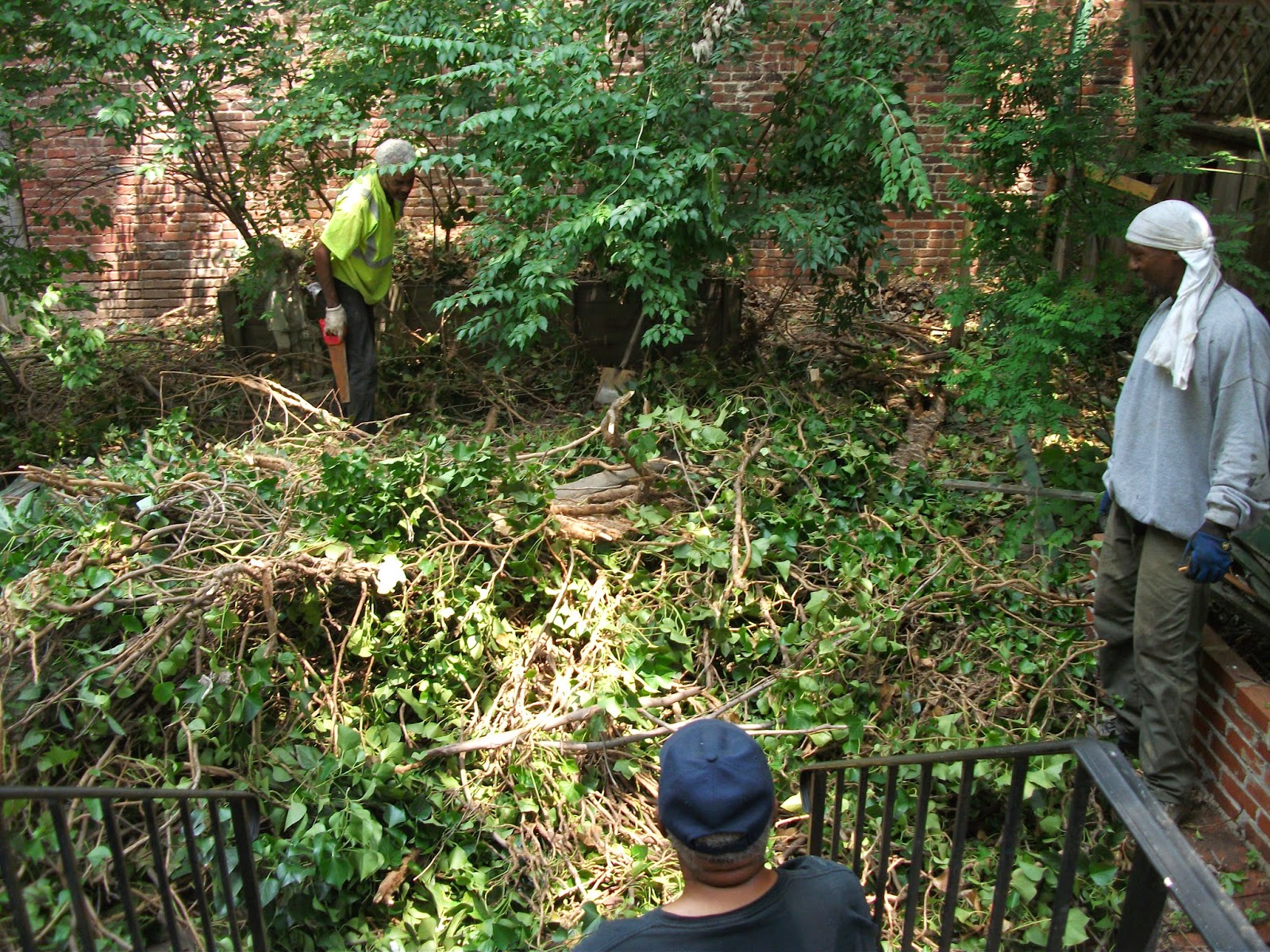
As per photos, heavy rain and just heavy growth led to the collapse of vines that had been growing on a back wall of my yard (actually, the side wall of another house) ever since we moved here in 1969. The house’s owner proposed that we split the considerable cost of cutting it down, which we did. I never knew ivy could fall like that, but, I suppose, like any living thing, its lifespan is limited. Only the naked wall is left. Meanwhile, an avocado plant I grew from a seed has taken over my back porch, so had to be trimmed.  I hope it won’t be harmed in the process.

 My visitors from Tanzania and Zambia have left, leaving a huge absence. The Tanzanian, a devout Catholic
(’m Catholic, but less devout), gave me a Bible Diary for 2014 with Pope Francis’s picture on the front cover
and daily readings inside. In turn, I gave her a copy of my Cuba book.

A friend and neighbor who, like me, joined the Peace Corps later in life and also once worked in Romania, as I did,
recently celebrated her 85th birthday. Our lives have had other parallels. Her former husband, who, like mine, divorced
her after a long marriage and remarried, also, like my late husband, served in the Carter administration. However,
similarities stop there, as her ex is still with the living and attended her birthday celebration, a fact which very much impressed me, as my ex-husband never set foot in our house again after he left and I cannot imagine him attending any event in my honor. After all that my friend has achieved since her divorce, I wonder if her former husband ever feels any regret for leaving her? Perhaps she, like me, found herself able to do much more as an independent person. [Sorry for spacing here, cannot correct it.]

 
Very interesting, first 2 copies of my Cuba book sold in euros—now one has been sold in pounds! How is this happening? It’s a real mystery. Maybe it will do better in Europe than here in the US?

 
Sunday Book review, Roanoke Times, posted July 9, 2014

By Humberto Rodríguez-Camilloni, PhD, Professor of Architecture, Virginia Tech

 
[cover image went here but is not reproducing]

This compelling autobiographical narrative brings into focus the reality of Cuba and the struggle of its people to survive in a world deprived of basic civil liberties, adequate food supplies, medical services, or education. The author — now in her mid-70s — has spent most of her adult life championing the cause of human rights around the world, but especially in Latin America, particularly in Cuba, a culture with which she has come to identify herself in a meaningful way with deep understanding and love. Once an admirer of Fidel Castro as a revolutionary hero, she has witnessed first hand his betrayal of the Cubans, who have not lived to see the realization of the promised democracy with freedom, social health care, economic prosperity and equal opportunity for all.NRVbookreview 071314

A description of the book is as follows: “Whatever your ethnic background or personal opinion of Fidel Castro, you will find something new and revealing in this book. It offers a frank, firsthand account of one woman’s journey, not only through Cuba, but through a life filled with unique challenges and tragedies, including the deaths of her older son and a Cuban foster son. When Castro rose to power, the author, like so many Americans, was entranced by the romantic vision of a scrubby revolutionary defeating the hated dictator Fulgencio Batista. But her years of direct experience with Cubans and within Cuba itself gradually eroded that vision. Then, unexpectedly, she found herself being attacked by a once close friend of Latino heritage. He not only vehemently disagreed with her negative evaluation of Castro’s reign, but harshly questioned her right as a non-Latina to even comment on it. He dubbed her ‘lazy’ and a ‘nunny-bunny,’ namely a phony gringa do-gooder, displaying what he called lamentable ‘Republican-style self-exculpation,’ thereby summarily dismissing her decades of involvement in Cuban human rights as an Amnesty International volunteer. These very personal attacks triggered her own self-doubts, launching her onto a meticulous look back over the 75-year trajectory of her entire life, especially her involvement with Latin America and Cuba.”

Joe writes with passion and great sensitivity, taking her readers on a lifetime journey full of adversities but also triumphs gained through persistent devotion and unconditional commitment to help others in need. As a self-proclaimed “humanitarian,” Joe’s life experiences provide timeless lessons for all. Like her previous award-winning memoir, “Triumph and Hope: Golden Years with the Peace Corps in Honduras” (2008), which should be read as a companion work, this book reasserts universal human values and the celebration of the human spirit that have guided the author throughout her entire life.

 
Putin’s courting anew of Cuba, forgiving its debt, offering to help with oil exploration, and renewing the spying post on the US, are very worrisome. If Russia returns to support Cuba, not only does that pose a risk to the United States, but means the prolonging of the Cuban dictatorship. 

 Folks calling for stronger barriers at the US-Mexico border don’t understand that the children and youths now congregating at the border are not actually crossing over. Rather, many are arriving at a fence, gate, or checkpoint and asking for asylum. According to a measure signed by GW Bush, those under age 18 coming from non-contiguous countries have a right in such cases to a hearing before an immigration judge. I’ve been an interpreter at many such hearings, though more recently, have preferred to work only in schools and hospitals. At “credible fear” hearings at the border where I’ve participated telephonically in the past, neither I nor the respondent (as they are called) knows the final decision at that moment, so I have no idea of which cases were sent along to an immigration judge and were actually allowed to stay and how many had to go. But, as I have said, I’ve often seen deportees arriving in immigration transport planes at the Tegucigalpa airport, like those shown above. I also have assisted young men whose legs were severed by trains in Mexico to obtain prostheses. Now, Mexico has apparently announced measures to prevent people from riding on top of freight trains, which should reduce both arrivals at the border and injuries and deaths from falling off. And maybe ads to stay home are working, as apparently the border arrivals are diminishing.

A friend and fellow Spanish interpreter has proposed having immigration hearings in the countries of origin, though I'm not sure those countries would allow it. It would save on migrants making a risky journey, then having to be sent back still owing the coyote. But citizens of other countries might demand the same, such as Syria, Iraq, and Gaza, where people certainly have a “credible fear.” As I may have said before, a teacher in a public kindergarten, with 40 students (!) told me that 5 had been born in the US, indicating their parents had been deported. Just on Sunday, a woman from Guatemala at our Spanish-speaking parental bereavement group, which I am now leading, told us that her 27-year-old son had been killed outside his auto body shop because he couldn't pay extortionists. He had called her the night before, saying. “They are trying to kill me.”

Now some folks from @amnesty are protesting the decision to deport kids from Central and South America @CNNpic.twitter.com/adakgQ59dX.

https://twitter.com/CNNewsCrew/status/489879549627203584/photo/1

 
Of course, the influx of kids—and mothers—from Central America is big news in the local Spanish-language press in free papers that come out weekly. One headline said, “No, no manden a sus hijos” [No, don’t send for your kids] quoting from a Guatemalan mother shown embracing her 14-year-old son who had just made the perilous journey—certainly a mixed message there. But at least 2 planeloads of Hondurans have been sent back already (as per photo), so that may make an impression. We have to hope they got due process, but if it’s very swift, who knows? On the other hand, if they are allowed to stay, that only encourages more. Some folks are saying that we should try to improve life at home for these people, but we’ve already been trying to do that for years with various programs, public and private, with only limited success. There will always be an income gap. Europe and Australia face similar refugee pressures. Canada has a big buffer in between.

 
Bolivia, apparently by presidential decree, has lowered the legal working age to 10 from the UN- mandated age of 14. Ten does seem awfully young, but recognizes de facto what actually occurs. Certainly in Honduras, where 14 is the legal age, it was recognized in the breach.

 
A member of our Caribbean staff at Amnesty International headquarters in London has published an article below in the Huffington Post, July 16, 2014, about the convoluted and ineffective way that the Dominican Republic is responding to its Haitian-descended citizen crisis engendered by a recent and internationally widely condemned high court decree.


 Bravo, regarding simplification and shortening of Peace Corps’ application process, as per article partially copied below. I remember waiting over a year for my assignment and many others have been discouraged by this prospect. Another change would be to encourage more older, experienced people to join, which is what receiving countries prefer. The agency has done that to an extent by opening up Peace Corps Response, usually 6-month tours, to experienced people who may already know the language and country involved but who have not served in the Peace Corps before. Allowing candidates to choose the country where they want to serve would have encouraged a number of people I’ve spoken with to join. Previously, such requests were met by PC recruiters with the pat answer, “We are not a travel agency” and expressing a country preference was often considered a sign of rigidity on the applicant’s part.

 Peace Corps announces major changes to application process

By T. Rees Shapiro Wash. Post, July 14, 2014  

 
The Peace Corps, formed more than 50 years ago to send Americans abroad to perform good works, is in the midst of its most serious challenge, with the number of applicants falling rapidly, leaving the volunteer force at its lowest level in more than a decade.

Recognizing that the organization envisioned by President John F. Kennedy could be endangered, its leaders are scheduled to announce Tuesday a series of steps to make it more attractive, including allowing candidates to choose the country where they want to serve, shortening the year-long application period, and recruiting more minorities and young people…In the past nine months, more than 30,000 potential candidates did not complete their applications, according to the Peace Corps. The number of candidates who have finished them has dropped from a peak of 15,384 in fiscal 2009 to 10,118 in fiscal 2013, a decline of 34 percent…The agency’s recruiting suffered setbacks after several volunteers came forward with harrowing accounts of sexual assaults in their host countries.

Hessler-Radelet said she hopes the improvements will encourage more people to apply and boost the agency’s number of volunteers, especially among minorities. Of the 7,200 volunteers currently deployed, whites make up 76 percent; blacks, 6 percent; Hispanics, 9 percent; and Asians, 5 percent.

“We want to make it simpler, faster and more personal than ever before,” she said. “We don’t want to make our application a barrier to entry.”

----------------------------------------------------------------------------

Good news! Remember Li Yan, a Chinese woman who was sentenced to death for the murder of her violent husband, who'd put her through months of domestic abuse?
Following intense international pressure, the Chinese authorities have overturned her death sentence - a very rare decision. Find out more:
http://amn.st/1m12jdR

 Small, oil-rich Equatorial Guinea is not a high profile country for Americans. As the only Spanish-speaking country in Africa, I only learned of its horrendous human rights record when translating some documents for Amnesty International. See letter below.

-------------------------------------------------------------------------------------

President and Chief Executive Officer Stephen Hayes on Africa
The Corporate Council on Africa
1100 17th Street, N.W., Suite 1000
Washington, DC 20036

Tel: (202) 835-1115 Fax: (202) 835-1117


Dear Chief Executive Officer Stephen Hayes,

 A supporter of Amnesty International, I’m writing about a deeply concerning situation of horrific treatment of prisoners in Equatorial Guinea. As I understand you will be honoring the country’s president in August, I appeal to you to confront him on these conditions.
 
Roberto Berardi was detained in February 2013, after making inquiries about revenues from a company he jointly owned with Second Vice President Teodoro Nguema Obiang Mangue (“Teodorin”), President Obiang’s eldest son. The company had been identified in US Department of Justice filings targeting properties held by Teodorin in California. Despite reported promises made by President Obiang to the EU Commission Vice President Antonio Tejani that Berardi would be released imminently, he remains in solitary confinement and very ill, according to his family. Photos show red lashing scars on Mr. Berardi’s back and an extreme loss of weight.

In July 2014, Mr. Berardi’s situation indicates that President Obiang has not improved conditions from when UN Special Rapporteur on Torture Manfred Nowak visited the country in November 2008 and reported that torture within the prisons was “rife” and that he feared prisoners would suffer reprisals for even talking to his team.

 Cruel and inhumane treatment in prisons should never be tolerated. The Universal Declaration of Human Rights, the United Nations Convention against Torture as well as the US Torture Victims Protection Act and the African Charter on Human and People’s Rights state that all people have the right to freedom from torture and cruel, inhuman or degrading treatment or punishment. The government of Equatorial Guinea cannot exempt itself from this prohibition.

 Moreover, Roberto Berardi’s detention was unlawful as it did not result from a fair trial or arrest in accordance with international standards. Though allegedly convicted of misappropriation of corporate assets and fraud, Berardi was presented with no evidence against him. Rather, it appears Berardi is being silenced and punished for inquiring into Obiang’s alleged misconduct uncovered by US authorities.

 As his time in prison progresses, Berardi has contracted a number of illnesses. He has been denied proper medical treatment and despite promises of his release from prison, he remains there, growing weaker and more ill.

 I urge you to prioritize human rights in your discussions with the President and all other involved groups about future cooperation and an end to the unjust treatment of Roberto Berardi and all other prisoners in Equatorial Guinea.  The poor human rights record of Equatorial Guinea over the years of Obiang’s government must be highlighted, stressing the need to end impunity for abuses. I ask you to express fears that the Equatorial Guinea government is encouraging abuses in prisons and unfair trials.  I further urge you to emphasize to the government the need to comply with international human rights law in handling issues that may put the Equatorial Guinea government under scrutiny. 

 This August President Obama will host President Obiang along with other heads of state from Africa in an effort to promote investment, trade and good governance in Africa. The Corporate Council on Africa will be holding a dinner in honor of President Obiang and will provide an opportunity to promote transparency, good governance and the rule of law and respect for human rights, all of which are essential to promoting investment and trade. Such conversations are null and void if investors in the country are detained and tortured at will.

 Thank you for your time and consideration of this important matter.