Sunday, April 14, 2013

Honduras Trip, Feb.--March, 2013, #2


Every year, I speculate about whether this will be my last trip to Honduras, yet I am now age 75 and this has been my 9th return trip since I left the Peace Corps at the end of 2003. So, we shall see about 2014. While I never make final plans until New Year’s Day, I do begin collecting give-away items long before. I will try to let photos do much of the talking this time, though it’s very hard for me to be brief. There is also the challenge that blog entries don’t normally flow in linear chronological order. Rather, the most recent entry always appears first. I'll try interspersing photos throughout. Please bear with me. Let's see how well I do. I'm so afraid of hitting the wrong button and erasing everything.  In fact, that has already  happen twice before with this posting, all work lost! Then I noticed the save button, rather belatedly. This 3rd time, it appears that I hit the wrong button again and it posted prematurely!! Oh dear.  So, here goes tyhe 4th attempt. I wonder if I can remove the version that went up without all the photos posted or whether there will be two trip postings close together, repeating the same text?  I will try to remove the incomplete one, if I can. Otherwise, there inevitably will be two. I need my own webmaster!!!

Below is some of my luggage, including several pairs of crutches, ready to go.

I noticed that Honduras’s daily papers were full of gruesome murder stories, not surprising in the country with the world’s highest per capita homicide rate. La Tribuna for Feb. 19 had articles about the teenage son of a former police chief gunned down after he had written an essay for an American college application entitled, “What would you do if tomorrow were the last day of your life?” La Tribuna has a daily front page column listing headlines for “Yesterday’s violent deaths,” including, on that particular day, “3 corpses found with evidence of torture,” “He was chased and liquidated with 5 gunshots,” “He went outside to get a better cell-phone signal and was cut down with a machete.” Graphic photos accompany many such stories. Also in that issue, 100,000 coffee harvesters lost their jobs because of a rampant coffee fungus. Honduran newspapers still carry a lot of want-ads since internet use is not widespread.

Of course, I noticed security guards all over the city, especially at two brand-new giant malls. I wondered how there was enough money available (drug money?) to have had them built and to sustain all the shops within. Every cab driver I asked had been robbed more than once. The exchange rate had reached 20 lempiras to the dollar, much easier to figure than when it was 18 or 19; now 100 L = $5. The exit fee was $38 this time. Above are businesses inside one new mall.

Was she the one?
As usual, I was offered hospitality by generous Hondurans all over the country and experienced only one unsettling stay in El Triunfo, two nights at the home of the mother of my old friend Jose Luis, a woman my own age recovering from an unspecified illness who had a 15-year-old girl, never met before, helping her out. I cannot be sure that girl was the culprit, but several items in my luggage went missing there and she seemed the most likely suspect, though I never mentioned anything to my hostess for fear of upsetting her about something I could not prove and I even left her one of my empty suitcases as a gift. See what you think; the missing items were deodorant, chapstick, lipstick, shampoo, conditioner, a number of Swiss vegetable peelers, several “magic towels” (which swell up when submerged in water), and a few small toys. They had been interspersed in my luggage, so she would have had to dig around to find them. I was gone for the day and had left my suitcases behind when these items, altogether probably worth not more than $70, disappeared. However, it was inconvenient, to say the least, to be without deodorant, chapstick, and shampoo in a very hot place like El Triunfo, where replacements were not available, which, I suppose, is why someone took them. I was giving away money and goods pretty freely, but according to my own judgment and volition and was quite upset by this theft, which shattered my trust. Nothing like that had ever happened before in that home on previous visits. I instinctively rely on my hosts to protect me. Fortunately, I had my little flashlight with me, so did lose it.

Below are photos inside an upscale home where I stayed in Teguc with a secluded inner patio with a fountain, but flanked on either side by noisy businsses, one a welding shop, the other an auto repair shop. The live-in maid and her daughter are shown eating dinner after serving the family. The maid also stands beside a gate that nearby neighbors have erected to keep unauthorized traffic out off their street.


Shrine to San Martin de Porres, Peruvian saint descended from African slaves

All the houses where I stayed acutely challenged my sensibilities, coming as I do from a family of architects (father, mother, brother, and nephew). All were built (jerry-built?) with cement blocks in stages. There were irregular heights of steps, unexpected ups and downs between rooms, light switches in odd places, and doors that wouldn’t close. After the precision of my own family’s architectural works, it’s always a surprise and disconcerting in Honduras, even in a fancy house, to find these irregularities. One city dwelling for a family of three (with 2 servants), was narrow, 4 stories tall (almost like my old row house in DC), filled with fancy furniture, statues, and paintings but located on an unpaved street sandwiched between a noisy welding shop and equally noisy car repair shop. No zoning, obviously, and nearby neighbors had closed off their streets with makeshift mental security gates manned by guards, apparently without seeking city permission.

In Teguc, my hostess was a teacher in a public kindergarten with 46 kids (!), three of whom, she told me, had been born in the US, but had come back to Honduras when their parents were deported. Even in Teguc, there was a day when the electricity was out for 12 hours. Businesses have generators, but not most private homes.

My trip had begun in Tegucigalpa, going from there to Choluteca and El Triunfo in the south, where the daily high temperature was over 100F. Then, I went from that weather to La Esperanza, which was hit by a cold spell, during which it went down into the 30’s F at night (no heat), so I slept with all my clothes on, including my jacket, and skipped the frigid morning shower. Thank goodness for two fleece wraps donated by my friend Brenda, which eventually went to the family of Sandra, my former leg-tumor patient. I traveled everywhere by bus, slowly shedding luggage along the way until, at the end, I only had my own carry-on left going home. Several newsworthy events happened during my visit, including the pope’s resignation and Hugo Chavez’s death. Some Hondurans were rooting for their own Cardinal Rodriguez to succeed Benedict, while others considered him corrupt, suspecting that he had enriched himself with Hurricane Mitch aid in 1998. Most were neutral about or pleased with the ascendancy of the Argentine Pope Francis. When Chavez died, I didn’t notice many tears, but heard on television accolades from deposed president, Manuel Zelaya, before his departure for the funeral in Caracas. Zelaya’s wife, Xiomara Castro, is one of several candidates in the November presidential election, representing a newly formed leftist party, though most people I talked with expected one of the major party candidates, Liberal or Nationalist, to win as usual. The father of the young doctor called Loni in my book is Zelaya’s wife’s uncle and plans to vote for her. I noticed that Loni’s father and mother seemed to be on better speaking terms when I stayed there this time than on previous visits, but still slept apart, something her mother instigated after discovering her husband’s other woman and other family. When one of Loni’s half-sisters by the other woman, a sister now living in the US, called her dad on Skype, I noticed that Loni’s mother stood by closely observing their conversation, but did not join in.

In Teguc, I visited the former Peace Corps headquarters, where the few remaining disconsolate employees were left to pack up and sell everything off. I saw a framed photo that I had taken, which also appears in my book, of boys with newspapers for sale; I should have asked to have it. Two former program directors have gone on temporary Peace Corps gigs to Paraguay and Guatemala, the latter my own health program director, Dr. Helmuth Castro. I also volunteered with Operation Smile’s harelip/cleft palate brigade while in Teguc, noting that most of the kids were return patients and only a few had never had surgery. That congenital abnormality, in large part the result of folic acid and other nutritional deficiencies during pregnancy, usually requires more than one remedial operation. This year, unfortunately, a dispute between the blind school director, Irma, adopted daughter of the late founder, Pilar Salinas, and members of the school staff (she is planning legal action) meant that I could not stay at the blind school, adjacent to San Felipe, the brigade hospital, but, rather, far across town, requiring me to seek out daily transportation. However, I still made a courtesy call to the blind school, where I talked with staff and kids I knew, but was not invited to stay.

Below is my framed photo hanging in the Peace Corps Headquarters entryway in Teguc of young newsboys. There follow goods being arrnaged for a giant "yard sale" of items in the PC office. Outside the front metal gate of the PC compound, an armed guard stands ready--another guard is at the back gate. At the residential blind school, a blind music teacher plays the piano to lead students in singing. Students play outside in the hallway after classes.


I also visited a center adjacent to the public San Felipe Hospital, a new facility built by Operation Smile providing year-round support to lip/palate kids. And I helped out with the annual Operation Smile medical brigade (below). I noted that many children arrived for second surgeries--follow up operations after their first.


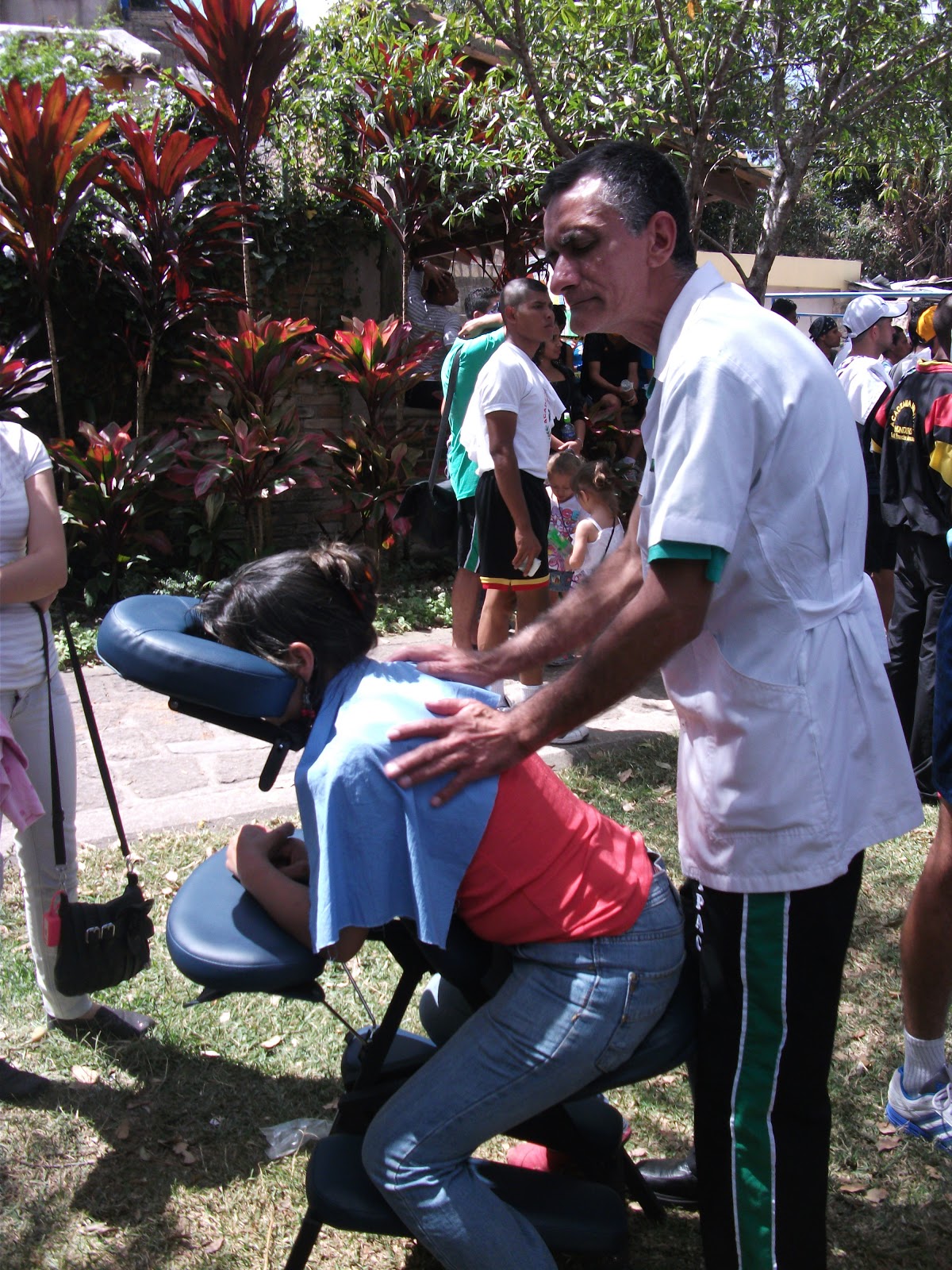
 Irma, though no longer with the blind school, still directs the adult blind training center in nearby Santa Lucia, where I observed blind trainees giving massages during an outdoor promotion and also had a massage myself. At the adult center, one young man sang me several songs to guitar accompaniment. Many lovely flowers bloomed in Irma's patio and all over Santa Lucia. Unfortunately, a fire started to clear fields got out of hand and went on for days, burning up a huge swath of trees outside Santa Lucia, but not reaching the town itself. The single ancient local fire truck kept going out to spray water from a small tank, which had no apparent effect. I thought of all our efforts as Peace Corps volunteers to distribute seedlings for planting and how, in a matter of days, so many mature trees had been totally wiped out. The smoke further polluted the air in Teguc, down the mountain, some 25 miles away.


In Choluteca, I bought some crutches and walkers at the San Jose Obrero Goodwill-type store and, in a cab, took them over to the rehab center, Teleton, along with 4 pairs of yard-sale crutches that I had brought from the States and that, miraculously, all bundled up together, were allowed to go through as luggage. At the center, I observed therapy with kids, including mirror therapy to improve their speech.

I’ve become somewhat discouraged by the erratic trajectories of young love, which in Honduras almost inevitably produce children. My longstanding scholarship student, Jorge, he of the amputated fingers, is now 20. I again located his house on the rundown outskirts of Choluteca, where I discovered that he is now “married” to a 16-year-old girl whom he met in high school last year, and so has not finished his last year of school because he now has to support her. The girl, who is staying with Jorge and his family, went with me to go find him in the small shop in town where he worked. It was one of those all-purpose pulperias selling snacks, candy, sodas, canned juice, cigarettes, and toilet paper, all from behind a grated iron enclosure with a small opening for passing through products and payment. When Jorge came outside momentarily to greet me, he said he does plan to graduate from high school and will let me know by mail or e-mail when he plans to go back to school. The girl friend told me that she also plans to return to school. I said that it was up to Jorge to contact me about his future educational plans. I gave him my e-mail and snail-mail addresses and some cash as a wedding present. But I doubt that Jorge will ever finish school as probably they will have a baby before very long. And then he will always struggle financially just like his father. I’ve done as much as possible over several years to promote his education and I’m glad he has a job now, however poorly paid, especially given Honduras’s dismal economic situation and the problem with his hand. And it’s also good that he has a girl friend despite his disfigured hand and his extreme self-consciousness about it, extending back through early childhood, when he was teased at school about having the middle fingers of both hands fused together. At least, we got the right hand fixed and, given the unfortunate outcome, I wish we had just left the left one alone.

Of course, in El Triunfo, I also visited the health center and gave it some donations of eyeglasses, bandages, and medicines, and went to the home of the mother of the girl with spina bifida, who had died a couple of years ago, and whom I had helped before with a water mattress, but that and a wheelchair were not enough to save her from a fierce pressure sore that eventually killed her. I always give the mother some cash, although her daughter is gone, as she is also raising a son as a single parent, her husband having left to live full time with his other woman. When a mother is abandoned by her husband for another woman, the latter is almost always younger. The abandoned mother rarely finds another partner herself nor does she get support, largely what happens in the United States as well, except that in Honduras, the left-behind mother usually has no legal recourse and receives no public aid. Among better-off couples, who, so far, rarely sever legal ties, child support may indeed be forthcoming if there is a legal divorce. However, in most cases, the wife merely overlooks her husband’s transgressions for her own good and that of their children. And occasionally the tables are turned and the wife goes off with another man, as happened to both Rev. Daniel and Jose Luis.

Two young women whom I have been helping with their education through the years, as with Jorge, have also been in common-law marriages, which have abruptly ended, leaving each with responsibility for raising a child with no support from the father and no legal recourse. Both, like Jorge, are now age 20. One is Neris, appearing with me on the lower right-hand corner of my Honduras book cover. She lives in El Triunfo, has graduated from high school with good grades, and, at one time, had wanted to enter a two-year nursing program in Choluteca, the nearest city, but then got pregnant and started living with her child’s father. She had a little girl, now almost 2. Since the Honduras academic year normally starts in Feb., I had sent my Triunfo friend with e-mail access, Jose Luis, over to her place last December to find out her intentions regarding nursing school and she told him then that she and her husband were dedicated to raising pigs, so she had no further plans for school. As I talked with her just now it Feb., her daughter and I were distracted by geckos running up and down the walls, but, suddenly, I started paying more attention to what she was saying. Sadly, she told me that the child’s father had left and she now wanted to revive her nursing school plans after all. She only had one pig left from their pig-raising enterprise and when it was gone, she was through with pigs. She said the nursing program had another enrollment period starting next August, so, as with Jorge, I gave her some cash to help with her child right now and told her to find out how much tuition, books, and transportation would come to and to let me know by snail mail or e-mail about the costs and enrollment. I did not promise to pay everything, only to see what I could do. I normally pay directly to the school. Her mother agreed to take care of her child. So far, no word from Neris on nursing school. Even though she is now 20, I still give her my old Christmas and birthday cards, something started when I was in the Peace Corps and continued ever since and which she has saved over the years, now possessing a large collection.


I’d like to send Jose Luis over there again to find out what Neris has decided about nursing school, but when I last saw him, his leg was in a cast after he’d had a motorcycle accident to avoid hitting a dog that had run out into his path. JL is the father of little twin girls, as well as of two other kids by his previous marriage. My last word from him was that his leg was not healing properly.


Of course, in El Triunfo, I visited post mistress Maria Elena, still on the job, and my would-be librarian friend, Pedro Joaquin, giving him a few books, among them a huge volume: The Brothers Karamazov in Spanish (thanks to my friend Anna, who once visited me in the Peace Corps in Honduras), and which he looked forward to reading himself. All this taking place in 100+ F temperatures as my clothes stuck to my body.


Besides Neris, the other young mother of particular concern is Marciel, also mentioned in my Honduras book. She makes tortillas in Guasaule at the border with Nicaragua and was pregnant last year when I saw her there, telling me happily that she was now married. Marciel has facial burn scars from an overturned kerosene lamp. I was unsuccessful in arranging to have remedial surgery for her. She is not affected functionally, only cosmetically, and any remedial surgery requires multiple interventions, which I simply could not manage. I had been glad last year that she had found a mate despite her scars. But, alas, her child’s father has also left and she now has a little boy almost a year old to raise by herself. I don’t think Marciel, who has not finished high school, is realistically a candidate for further education, so I simply gave her some money to help with her child, distressed to see her standing there all day long, hand-making tortillas 7 days a week, with her baby at her side, as her mother had done before her.


In Guasaule, as elsewhere, people I didn’t remember, called out to me, “Dona Barbara,” and clamored for me to talk with them or buy their wares. The same had happened to me in El Triunfo. It’s always surprising to me to be such a famous person in Honduras when I only go there once a year.


Meanwhile, before planning to visit Guasaule, I had hired a motorized “rapidito” for the day to take me both there and to see my former village health volunteers, Lea and Blanca. Those 3-wheeled little carts, similar to those used in Managua, were marketed to Honduran small towns by Indian manufacturers, who sold them on credit. This was the first time I’d seen them in El Triunfo and they had completely cut into the business of foot-pedaled carts that charged the same rates.


Before setting off for the villages, I learned that Lea, my village helper living farthest away, in Matapalos, had died of a heart attack a few months earlier and her husband soon after. Well, I thought, then we don’t need to go there. But, no, word had already gone out that I was in town and her children were expecting me to arrive there. So I had to go anyway and also to see Blanca in Rio Grande #1. In Matapalos, I found the small black and white TV set I had brought them years before still in use, powered by a car battery. When people are so excited to see you, it makes getting there worth the effort, so I was not sorry to have gone.


In Guasaule, I found my wheelchair lady, Bessy, out begging at the border. She was wearing some clothes I had given her previously and I brought her some more. She begged me to give her enough money to buy a cell phone. I was worried that someone might take the money, which she tucked into her blouse, or else steal her cell phone, but several people nearby assured me that they would protect her from robbery. I do hope they were not thieves themselves.


I traveled from Choluteca to La Esperanza in one day, leaving early in the morning and, thanks to a tip from schoolteacher friend Belsa, got on an early morning bus straight through Teguc headed to San Pedro Sula on the north coast, getting off myself at Siguat (Siguatepeque) to wait for a bus to La Esperanza. That way, I would avoid having to travel between terminals in Teguc with a still heavy duffle bag and other luggage. To my surprise, as it was still the dry season, rain was falling and a cold wind was blowing. I was let off by the side of the highway and had to cross with cars and trucks whizzing by. I didn’t know whether I could make it across safely with all my luggage and I was quickly getting soaked just standing there. Suddenly, a barefoot young man who seemed to have suffered a partial stroke, picked up my big duffle bag and, with an unsteady gait, made his way across, with me following with the other suitcases. I hoped he wouldn’t steal my bag. He did not. He told me where to wait for the Esperanza bus and, of course, I gave him a tip. I wish I had had some shoes to give him.


In La Esperanza, Luis was now working with Save the Children, an organization that allows him to park hi car in their compound during the week and to make his rounds in a motorcycle that he takes home during the week, saving on gas. His family now has a new live-in maid, 15-year-old Salome. I gave her a shawl that my clothes vendor friend, Dona Chunga, had given me. Chunguita, her own younger daughter, depicted in my book, is now pregnant with her second child, much to Chunga’s dismayl. Chunga herself had 13 children before her husband was shot to death, but, as she said, “Back then, we didn’t know how t prevent it.” Chunga said that after several tries when her request was turned down (and she still lost the $120 visa interview fee), she was finally granted a visitor’s visa to visit some of her children in Maryland, so I may see her soon.


At my expense, my young leg tumor patient, Sandra, now 13, and her mother came to meet me in La Esperanza, having received the request via their cell phone. Their oldest son is a nursing student attending a 2-year course offered privately by a group of nurses, including Luis’s wife Wendy. Wendy told me that he’s a very good and eager student. So, when Sandra and her mother arrived, of course, I had to give her some money to help pay her son’s tuition and expenses, as well as giving her the big duffle bag and all the clothes inside. Since the nursing courses are given in La Esperanza, the son stays in town during the week, going home only on weekends. I examined Sandra’s leg, which has had two surgeries, but saw no sign of a return of the tumor. I urged Sandra to attend school, better late than never, but the mother did not want Sandra to go to school, contending that it is too far for her to walk and that she has already missed too many years. Besides, her mother likes having her at home to help out, including with caring for a baby sister born soon after my visit last year, the only other girl among the 7 children. Sandra herself said she prefers staying home and I saw it was losing battle to try to get her into school. The mother proudly told me that she is now getting contraceptives (called “control” in Spanish) from her local health center and plans on having no more children. Thank goodness for that.


Although my usual IHS medical was cancelled at the last minute for lack of doctors, besides Operation Smile in Teguc, I joined two other brigades in La Esperanza, one a general medical brigade of church people from Georgia working mostly in nearby Yamaranguila, the other, a dental brigade run by the Lions Club, better known for distributing eyeglasses and providing eye surgery. I also visited the town of Jesus de Otoro, where I met a single mother with two boys with spina bifida. The older, age 12 years, had a deep pressure sore on his buttocks. I took no photos there because the boy was stripped naked from the waist because of this sore. I urged the mother to take him to the teaching hospital in Teguc, remembering my girl with spina bifida who died from a pressure sore in El Triunfo, though, of course, I didn’t tell the mother that. I gave her some money for her trip, but she said she had no one to watch the other boy while she was away. I didn’t know what to recommend there. Both boys had wheelchairs, but water cushions would have helped prevent pressure sores. I advised the mother to ask about that when she took her son to Teguc.


In Jesus de Otoro, a wheelchair that the Esperanza Red Cross had saved for me from a previous IHS medical brigade, I donated to a maternity center. There I met 2 mothers who had just given birth. One had a cute newborn girl who was nursing well, her first child. The other had given birth to a baby boy with a severe harelip and cleft palate. She was in tears, after having had two boys with no abnormalities. The baby could not suck. We bought some powdered formula and mixed it with purified water after which a nurse tried to show the mother how to feed the baby with a syringe. The milk kept coming out of his nose. Seeing the woman in the other bed nursing her perfect baby only made the boy’s mother cry even harder. I foresaw all sorts of problems with syringe feeding, not only in terms of getting a grasp of the technique, but in being able to purchase the formula and keep the equipment sterile. I told the mother that if the child gained enough weight, he might be able to have surgery at 3 months. Her own milk had not come in yet perhaps because of the shock.


When Luis and I got back to his home in La Esperanza, we discussed our concerns with his nurse wife, Wendy, and arranged for the mother of the cleft baby to spend a few days in the local hospital with nurses there to learn how to feed him. Wendy herself checked up on him after the child and his mother were admitted. She said that the mother had produced some breast milk and was expressing it manually (no breast pumps) and was having some success with syringe feeding. I also urged the mother to go to Teguc to the Operation Smile clinic there, but then I had to leave Honduras and Luis has not answered my follow up e-mails asking if she ever went. That clinic could help her further with feeding and would also put her baby on the future surgery schedule. The sooner he can have surgery, the easier the family’s life will be all around, not to mention that the child’s survival may be at stake. Whenever I leave Honduras, I always feel that my efforts are a tiny drop in the vast ocean of need.


I had booked a first-class flight from Miami to DC, as it was the only one available on the day of my return not requiring a stop and change of planes and I knew I would not be up for that after my long visit. To my surprise, even the leg between Teguc and Miami was first class. I had never flown first class before and it was quite enjoyable, though not something I would seek to do again. I was offered wine and an actual meal and had a roomy seat. In Miami, during only 3 days, I saw my Cuban protƩgƩ Armando (with a hereditary kidney disease) and his family, brother Bob and his girl friend Jean, and Bolivian architect Carlos and his wife Karen, as well as 20-year former Cuban political prisoner and poet-playwright Jorge Valls. So, we shall see about next year, Primero Dios.

Honduras Trip, Feb.--March, 2013


Every year, I speculate about whether this will be my last trip to Honduras.  I'm now age 75 and this has been my 9th return trip since I left the Peace Corps at the end of 2003. So, we shall see about 2014. While I never make final plans until New Year’s Day, I do begin collecting give-away items long before. I will try to let photos do most of the talking this time, though it’s very hard for me to be brief.  Please bear with me. We’ll see how well I do. Already, this is the 3rd time I'm posting this with photos, a very arduous process. With a sudden inadvertant movement, such as trying to shirnk or move a photo, everything can be erased--hours of work lost. That's happened to me twice already now. I see, belatedly, that there seems to be a "save" option. Will try saving as I go along this time.  And will not try to move or shrink photos, as that's how I got in trouble before.

Below, some of my luggage before departure, including bundled sets of crutches.


When I first arrived, I was strruck that Honduras’s daily papers were so full of gruesome murder stories, really not so surprising in the country with the world’s highest per capita homicide rate. La Tribuna for Feb. 19 had articles about the teenage son of a former police chief gunned down after he had written an essay for an American college application entitled, “What would you do if tomorrow were the last day of your life?” La Tribuna has a daily front page column listing headlines for “Yesterday’s violent deaths,” including, on that particular day, “3 corpses found with evidence of torture,” “He was chased and liquidated with 5 gunshots,” “He went outside to get a better cell-phone signal and was cut down with a machete.” Graphic photos accompany  such stories. Also in that issue, 100,000 coffee harvesters lost their jobs because of a rampant coffee fungus. Unlike their US counterparts, Honduran newspapers still carry a lot of want-ads since internet use is not widespread.


Of course, I noticed security guards all over the city, especially at two brand-new giant malls, pictured above. I wondered how there was enough money available (drug money?) to have had them built and to sustain all the shops within. Every cab driver I asked had been robbed more than once. The exchange rate had reached 20 lempiras to the dollar, much easier to figure than when it was 18 or 19; now 100 L = $5. The exit fee was $38 this time.

Was she the one?
As usual, I was offered hospitality by generous Hondurans all over the country and experienced only one unsettling stay in El Triunfo, two nights at the home of the mother of my old friend Jose Luis, a woman my own age recovering from an unspecified illness who had a 15-year-old girl, never met before, helping her out. I cannot be sure that girl was the culprit, but several items in my luggage went missing there and she seemed the most likely suspect, though I never mentioned anything to my hostess for fear of upsetting her about something I could not prove and I even left her one of my empty suitcases as a gift. See what you think; the missing items were deodorant, chapstick, lipstick, shampoo, conditioner, a number of Swiss vegetable peelers, several “magic towels” (which swell up when submerged in water), and a few small toys. They had been interspersed in my luggage, so she would have had to dig around to find them. I was gone for the day and had left my suitcases behind when these items, altogether probably worth not more than $70, disappeared. However, it was inconvenient, to say the least, to be without deodorant, chapstick, and shampoo in a very hot place like El Triunfo, where replacements were not available, which, I suppose, is why someone took them. I was giving away money and goods pretty freely, but according to my own judgment and volition and was quite upset by this theft, which shattered my trust. Nothing like that had ever happened before in that home on previous visits. I instinctively rely on my hosts to protect me. Fortunately, I had my little flashlight with me, so did not lose it. Above is a photo of my suspect, sweeping up the yard and looking quite innocent.

Below are photos from an upsacle house where I stayed in Tegucigalpa, sandwiched between a noisy welding shop and a noisy car repair shop. The live-in maid and her daughter are shown eating after the family. The maid also stands before a nearby street that residents have blocked off from outside traffic.


All the houses where I stayed acutely challenged my sensibilities, coming as I do from a family of architects (father, mother, brother, and nephew). All were built (jerry-built?) with cement blocks in stages. There were irregular heights of steps, unexpected ups and downs between rooms, light switches in odd places, and doors that wouldn’t close. After the precision of my own family’s architectural works, it’s always been a surprise and disconcerting in Honduras, even in a fancy house, to find these irregularities. One city dwelling for a family of three (with 2 servants, above), was narrow, 4 stories tall (almost like my old row house in DC), filled with fancy furniture, statues, and paintings but located on an unpaved street between a noisy welding shop and equally noisy car repair shop. No zoning, obviously, and nearby neighbors had closed off their streets with makeshift mental security gates manned by guards, apparently without seeking city permission.

In Teguc, my hostess was a teacher in a public kindergarten with 46 kids (!), three of whom, she told me, had been born in the US, but had come back to Honduras when their parents were deported. Even in Teguc, there was a day when the electricity was out for 12 hours. Businesses have generators, but not most private homes.

My trip had begun in Tegucigalpa, going from there to Choluteca and El Triunfo in the south, where the daily high temperature was over 100F. Then, I went from that weather to La Esperanza, which was hit by a cold spell, during which it went down into the 30’s F at night (no heat), so I slept with all my clothes on, including my jacket, and skipped the frigid morning shower. Thank goodness for two fleece wraps donated by my friend Brenda, which eventually went to the family of Sandra, my former leg-tumor patient. I traveled everywhere by bus, slowly shedding items and luggage along the way until, at the end, I only had my own carry-on left for going home. Several newsworthy events happened during my visit, including the pope’s resignation and Hugo Chavez’s death. Some Hondurans were rooting for their own Cardinal Rodriguez to succeed Benedict, while others considered him corrupt, suspecting that he had enriched himself with Hurricane Mitch aid in 1998. Most were neutral about or pleased with the ascendancy of the Argentine Pope Francis. When Chavez died, I didn’t notice many tears, but heard on television accolades from deposed president, Manuel Zelaya, before his departure for the funeral in Caracas. Zelaya’s wife, Xiomara Castro, is one of several candidates in the November presidential election, representing a newly formed leftist party, though most people I talked with expected one of the major party candidates, Liberal or Nationalist, to win as usual. The father of the young doctor called Loni in my book is Zelaya’s wife’s uncle and plans to vote for her. I noticed that Loni’s father and mother seemed to be on better speaking terms when I stayed there this time than on previous visits, but still slept apart, something her mother instigated after discovering her husband’s other woman and other family. When one of Loni’s half-sisters by the other woman, a sister now living in the US, called her dad on Skype, I noticed that Loni’s mother stood by closely observing their conversation, but did not join in.

In Teguc, I had visited the former Peace Corps headquarters, where the few remaining disconsolate employees were left to pack up and sell everything off. There, I saw a framed photo in the entryway that I had taken, which also appears in my book, of young newsboys; I should have asked to have it. Two former program directors have gone on temporary Peace Corps gigs to Paraguay and Guatemala, the latter my own health program director, Dr. Helmuth Castro. All furniture and office supplies were being sold off in a giant yard sale, so sad. An armed guard stood at the front metal gate and also one at the rear gate.


My photo hung in the former PC Honduras entryway


Blind school students below sing along with their blind piano-playing teacher, then gather outside after classes.


I also volunteered with Operation Smile’s harelip/cleft palate brigade while in Teguc, noting that most of the kids were return patients and only a few had never had surgery. That congenital abnormality, largely the result of folic acid and other nutritional deficiencies during pregnancy, usually requires more than one remedial operation. This year, unfortunately, a dispute between the blind school director, Irma, adopted daughter of the late founder, Pilar Salinas, and members of the school staff (she is planning legal action) meant that I could not stay at the blind school, adjacent to San Felipe, the brigade hospital, but, rather, far across town, requiring me to seek out daily transportation. However, I still made a courtesy call to the blind school, where I talked with staff and kids I knew, but was not invited to stay. I also visited a center adjacent to the public San Felipe Hospital, a new facility built by Operation Smile providing year-round support to lip/palate kids.


Irma, meanwhile, still directs the adult blind training center in nearby Santa Lucia, where I observed blind trainees giving massages during an outdoor promotion and also had a massage myself. At the adult center, one young man sang me several songs to guitar accompaniment. Many lovely flowers in Santa Lucia, including in Irma's garden--also plump red bananas, one of several banana species in Honduras--here in the US, we mostly know only large yellow ones. Unfortunately, a fire started to clear nearby fields got out of hand and went on for days, burning up a huge swath of trees outside Santa Lucia, but not reaching the town itself. The single ancient local fire truck kept going out to spray water from a small tank, which had no apparent effect. I thought of all our efforts as Peace Corps volunteers to distribute seedlings for planting and how, in a matter of days, so many mature trees had been totally wiped out. The smoke further polluted the air in Teguc, down the mountain, some 25 miles away.


CAIPAC entrance, adult blind residential center, Santa Lucia

Young blind woman "looks" for her clothes on the line.


Three women residing at the adult center chat while 2 share earphones to hear music.


I once stayed in this women's dorm, but not this time.


Below, scenes from Snata Lucia


In Choluteca, I bought some crutches and walkers at the San Jose Obrero Goodwill-type store and, in a cab, took them over to the rehab center, Teleton, along with 4 pairs of yard-sale crutches that I had brought from the States and that, miraculously, all bundled up together, were allowed to go through as luggage. At the center, I observed therapy with kids, including mirror therapy to improve their speech.


I’ve become somewhat discouraged by the erratic trajectories of young love, which in Honduras almost inevitably produce children. My longstanding scholarship student, Jorge, he of the amputated fingers, is now 20. I again located his house on the rundown outskirts of Choluteca, where I discovered that he is now “married” to a 16-year-old girl whom he met in high school last year, and so has not finished his last year of school because he now has to support her. The girl, who is staying with Jorge and his family, went with me to go find him in the small shop in town where he worked. It was one of those all-purpose pulperias selling snacks, candy, sodas, canned juice, cigarettes, and toilet paper, all from behind a grated iron enclosure with a small opening for passing through products and payment. When Jorge came outside momentarily to greet me, he said he does plan to graduate from high school and will let me know by mail or e-mail when he plans to go back to school. The girl friend told me that she also plans to return to school. I said that it was up to Jorge to contact me about his future educational plans. I gave him my e-mail and snail-mail addresses and some cash as a wedding present. But I doubt that Jorge will ever finish school as probably they will have a baby before very long. And then he will always struggle financially just like his father. I’ve done as much as possible over several years to promote his education and I’m glad he has a job now, however poorly paid, especially given Honduras’s dismal economic situation and the problem with his hand. And it’s also good that he has a girl friend despite his disfigured hand and his extreme self-consciousness about it, extending back through early childhood, when he was teased at school about having the middle fingers of both hands fused together. At least, we got the right hand fixed and, given the unfortunate outcome, I wish we had just left the left one alone.


Of course, in El Triunfo, I also visited the health center and gave it some donations of eyeglasses, bandages, and medicines, and went to the home of the mother of the girl with spina bifida, who had died a couple of years ago, and whom I had helped before with a water mattress, but that and a wheelchair were not enough to save her from a fierce pressure sore that eventually killed her. I always give the mother some cash, although her daughter is gone, as she is also raising a son as a single parent, her husband having left to live full time with his other woman. When a mother is abandoned by her husband for another woman, the latter is almost always younger. The abandoned mother rarely finds another partner herself nor does she get support, largely what happens in the United States as well, except that in Honduras, the left-behind mother usually has no legal recourse and receives no public aid. Among better-off couples, who, so far, rarely sever legal ties, child support may indeed be forthcoming if there is a legal divorce. However, in most cases, the wife merely overlooks her husband’s transgressions for her own good and that of their children. And occasionally the tables are turned and the wife goes off with another man, as happened to both Rev. Daniel and Jose Luis.


Two young women whom I have been helping with their education through the years, as with Jorge, have also been in common-law marriages, which have abruptly ended, leaving each with responsibility for raising a child with no support from the father and no legal recourse. Both, like Jorge, are now age 20. One is Neris, appearing with me on the lower right-hand corner of my Honduras book cover. She lives in El Triunfo, has graduated from high school with good grades, and, at one time, had wanted to enter a two-year nursing program in Choluteca, the nearest city, but then got pregnant and started living with her child’s father. She had a little girl, now almost 2. Since the Honduras academic year normally starts in Feb., I had sent my Triunfo friend with e-mail access, Jose Luis, over to her place last December to find out her intentions regarding nursing school and she told him then that she and her husband were dedicated to raising pigs, so she had no further plans for school. As I talked with her just now it Feb., her daughter and I were distracted by geckos running up and down the walls, but, suddenly, I started paying more attention to what she was saying. Sadly, she told me that the child’s father had left and she now wanted to revive her nursing school plans after all. She only had one pig left from their pig-raising enterprise and when it was gone, she was through with pigs. She said the nursing program had another enrollment period starting next August, so, as with Jorge, I gave her some cash to help with her child right now and told her to find out how much tuition, books, and transportation would come to and to let me know by snail mail or e-mail about the costs and enrollment. I did not promise to pay everything, only to see what I could do. I normally pay directly to the school. Her mother agreed to take care of her child. So far, no word from Neris on nursing school. Even though she is now 20, I still give her my old Christmas and birthday cards, something started when I was in the Peace Corps and continued ever since and which she has saved over the years, now possessing a large collection.


I’d like to send Jose Luis over there again to find out what Neris has decided about nursing school, but when I last saw him, his leg was in a cast after he’d had a motorcycle accident to avoid hitting a dog that had run out into his path. JL is the father of little twin girls, as well as of two other kids by his previous marriage. My last word from him was that his leg was not healing properly.


Of course, in El Triunfo, I visited post mistress Maria Elena, still on the job, and my would-be librarian friend, Pedro Joaquin, giving him a few books, among them a huge volume: The Brothers Karamazov in Spanish (thanks to my friend Anna, who once visited me in the Peace Corps in Honduras), and which he looked forward to reading himself. All this taking place in 100+ F temperatures as my clothes stuck to my body.


Besides Neris, the other young mother of particular concern is Marciel, also mentioned in my Honduras book. She makes tortillas in Guasaule at the border with Nicaragua and was pregnant last year when I saw her there, telling me happily that she was now married. Marciel has facial burn scars from an overturned kerosene lamp. I was unsuccessful in arranging to have remedial surgery for her. She is not affected functionally, only cosmetically, and any remedial surgery requires multiple interventions, which I simply could not manage. I had been glad last year that she had found a mate despite her scars. But, alas, her child’s father has also left and she now has a little boy almost a year old to raise by herself. I don’t think Marciel, who has not finished high school, is realistically a candidate for further education, so I simply gave her some money to help with her child, distressed to see her standing there all day long, hand-making tortillas 7 days a week, with her baby at her side, as her mother had done before her.


In Guasaule, as elsewhere, people I didn’t remember, called out to me, “Dona Barbara,” and clamored for me to talk with them or buy their wares. The same had happened to me in El Triunfo. It’s always surprising to me to be such a famous person in Honduras when I only go there once a year.


Meanwhile, before planning to visit Guasaule, I had hired a motorized “rapidito” for the day to take me both there and to see my former village health volunteers, Lea and Blanca. Those 3-wheeled little carts, similar to those used in Managua, were marketed to Honduran small towns by Indian manufacturers, who sold them on credit. This was the first time I’d seen them in El Triunfo and they had completely cut into the business of foot-pedaled carts that charged the same rates.


Before setting off for the villages, I learned that Lea, my village helper living farthest away, in Matapalos, had died of a heart attack a few months earlier and her husband soon after. Well, I thought, then we don’t need to go there. But, no, word had already gone out that I was in town and her children were expecting me to arrive there. So I had to go anyway and also to see Blanca in Rio Grande #1. In Matapalos, I found the small black and white TV set I had brought them years before still in use, powered by a car battery. When people are so excited to see you, it makes getting there worth the effort, so I was not sorry to have gone.


In Guasaule, I found my wheelchair lady, Bessy, out begging at the border. She was wearing some clothes I had given her previously and I brought her some more. She begged me to give her enough money to buy a cell phone. I was worried that someone might take the money, which she tucked into her blouse, or else steal her cell phone, but several people nearby assured me that they would protect her from robbery. I do hope they were not thieves themselves.


I traveled from Choluteca to La Esperanza in one day, leaving early in the morning and, thanks to a tip from schoolteacher friend Belsa, got on an early morning bus straight through Teguc headed to San Pedro Sula on the north coast, getting off myself at Siguat (Siguatepeque) to wait for a bus to La Esperanza. That way, I would avoid having to travel between terminals in Teguc with a still heavy duffle bag and other luggage. To my surprise, as it was still the dry season, rain was falling and a cold wind was blowing. I was let off by the side of the highway and had to cross with cars and trucks whizzing by. I didn’t know whether I could make it across safely with all my luggage and I was quickly getting soaked just standing there. Suddenly, a barefoot young man who seemed to have suffered a partial stroke, picked up my big duffle bag and, with an unsteady gait, made his way across, with me following with the other suitcases. I hoped he wouldn’t steal my bag. He did not. He told me where to wait for the Esperanza bus and, of course, I gave him a tip. I wish I had had some shoes to give him.


In La Esperanza, Luis was now working with Save the Children, an organization that allows him to park hi car in their compound during the week and to make his rounds in a motorcycle that he takes home during the week, saving on gas. His family now has a new live-in maid, 15-year-old Salome. I gave her a shawl that my clothes vendor friend, Dona Chunga, had given me. Chunguita, her own younger daughter, depicted in my book, is now pregnant with her second child, much to Chunga’s dismayl. Chunga herself had 13 children before her husband was shot to death, but, as she said, “Back then, we didn’t know how t prevent it.” Chunga said that after several tries when her request was turned down (and she still lost the $120 visa interview fee), she was finally granted a visitor’s visa to visit some of her children in Maryland, so I may see her soon.


At my expense, my young leg tumor patient, Sandra, now 13, and her mother came to meet me in La Esperanza, having received the request via their cell phone. Their oldest son is a nursing student attending a 2-year course offered privately by a group of nurses, including Luis’s wife Wendy. Wendy told me that he’s a very good and eager student. So, when Sandra and her mother arrived, of course, I had to give her some money to help pay her son’s tuition and expenses, as well as giving her the big duffle bag and all the clothes inside. Since the nursing courses are given in La Esperanza, the son stays in town during the week, going home only on weekends. I examined Sandra’s leg, which has had two surgeries, but saw no sign of a return of the tumor. I urged Sandra to attend school, better late than never, but the mother did not want Sandra to go to school, contending that it is too far for her to walk and that she has already missed too many years. Besides, her mother likes having her at home to help out, including with caring for a baby sister born soon after my visit last year, the only other girl among the 7 children. Sandra herself said she prefers staying home and I saw it was losing battle to try to get her into school. The mother proudly told me that she is now getting contraceptives (called “control” in Spanish) from her local health center and plans on having no more children. Thank goodness for that.


Although my usual IHS medical was cancelled at the last minute for lack of doctors, besides Operation Smile in Teguc, I joined two other brigades in La Esperanza, one a general medical brigade of church people from Georgia working mostly in nearby Yamaranguila, the other, a dental brigade run by the Lions Club, better known for distributing eyeglasses and providing eye surgery. I also visited the town of Jesus de Otoro, where I met a single mother with two boys with spina bifida. The older, age 12 years, had a deep pressure sore on his buttocks. I took no photos there because the boy was stripped naked from the waist because of this sore. I urged the mother to take him to the teaching hospital in Teguc, remembering my girl with spina bifida who died from a pressure sore in El Triunfo, though, of course, I didn’t tell the mother that. I gave her some money for her trip, but she said she had no one to watch the other boy while she was away. I didn’t know what to recommend there. Both boys had wheelchairs, but water cushions would have helped prevent pressure sores. I advised the mother to ask about that when she took her son to Teguc.


In Jesus de Otoro, a wheelchair that the Esperanza Red Cross had saved for me from a previous IHS medical brigade, I donated to a maternity center. There I met 2 mothers who had just given birth. One had a cute newborn girl who was nursing well, her first child. The other had given birth to a baby boy with a severe harelip and cleft palate. She was in tears, after having had two boys with no abnormalities. The baby could not suck. We bought some powdered formula and mixed it with purified water after which a nurse tried to show the mother how to feed the baby with a syringe. The milk kept coming out of his nose. Seeing the woman in the other bed nursing her perfect baby only made the boy’s mother cry even harder. I foresaw all sorts of problems with syringe feeding, not only in terms of getting a grasp of the technique, but in being able to purchase the formula and keep the equipment sterile. I told the mother that if the child gained enough weight, he might be able to have surgery at 3 months. Her own milk had not come in yet perhaps because of the shock.


When Luis and I got back to his home in La Esperanza, we discussed our concerns with his nurse wife, Wendy, and arranged for the mother of the cleft baby to spend a few days in the local hospital with nurses there to learn how to feed him. Wendy herself checked up on him after the child and his mother were admitted. She said that the mother had produced some breast milk and was expressing it manually (no breast pumps) and was having some success with syringe feeding. I also urged the mother to go to Teguc to the Operation Smile clinic there, but then I had to leave Honduras and Luis has not answered my follow up e-mails asking if she ever went. That clinic could help her further with feeding and would also put her baby on the future surgery schedule. The sooner he can have surgery, the easier the family’s life will be all around, not to mention that the child’s survival may be at stake. Whenever I leave Honduras, I always feel that my efforts are a tiny drop in the vast ocean of need.


I had booked a first-class flight from Miami to DC, as it was the only one available on the day of my return not requiring a stop and change of planes and I knew I would not be up for that after my long visit. To my surprise, even the leg between Teguc and Miami was first class. I had never flown first class before and it was quite enjoyable, though not something I would seek to do again. I was offered wine and an actual meal and had a roomy seat. In Miami, during only 3 days, I saw my Cuban protƩgƩ Armando (with a hereditary kidney disease) and his family, brother Bob and his girl friend Jean, and Bolivian architect Carlos and his wife Karen, as well as 20-year former Cuban political prisoner and poet-playwright Jorge Valls. So, we shall see about next year, Primero Dios.


Friday, April 5, 2013

Get-on-the-Bus, Human Rights, Honduras, Peace Corps, Cuba, Gay Marriage & Kids, Dementia, Jimmy Carter, Social Security, White Men & Guns


Next time, I promise to post photos and a report on my Honduras trip. Just how to handle the photos is a challenge, as not every photo requires a caption, but some still do. Right now, my priority is planning for another Amnesty International event taking place on Friday, April 12, called “Get-on-the-Bus” involving a march to and demonstrations at various embassies. We don’t actually get on a bus, but walk between the embassies. Usually, no one comes out while we are there, though if they did, we would ask them about the case or issue that is the focus of our demonstration. A case for the Dominican Republic Embassy is that of Juan Almonte, who disappeared on September 28, 2009 after being abducted by four armed men, presumably from the police. I have been in touch with his wife (widow?), who now lives in New York City, but she is unable to join us.


On March 22, Ecuador, backed by Bolivia, Nicaragua and Venezuela, tried unsuccessfully to curb both the power and finances of the Inter-American Human Rights Commission.

Honduras, according to a recent report, has 70,000 private security guards, far outnumbering the army and police combined.

Just checked in on the weather in Honduras, now that we are experiencing an unusually cold spell in the eastern United States due, apparently, to a blocking air mass. (My Kenyan visitors cannot believe how chilly DC weather is.) Well, the cold spell certainly hasn’t reached Honduras, where predicted high temperatures all week will exceed 100 F in Choluteca, rising as high as 106 F. but getting a little below 80 F at night. Whew! I remember those steamy April days and nights so well. In Tegucigalpa, it also quite warm, in the 90s, getting down to the high 60s at night, which should provide some relief. Even in La Esperanza, it is in the 80s, down to the 50s at night. April is usually the hottest month because it is still the dry season with marginally longer days. May’s rains will cool things down somewhat, but increase humidity in the south. The rainy season, with a small “Indian summer” in August, will last until November. The only time the weather is bearable in the south is in December, dry with slightly shorter days, when the high temperature may only reach into the 80s. That’s why I left there after 2+ years.

At a Peace Corps “town hall” meeting for former and future volunteers, staff, and interested parties, acting director Carrie Hessler-Radelet confirmed that the number of volunteers recruited annually will probably have to be cut by 200 to 300 because of the sequester and budget constraints. Any return of the Peace Corps to Honduras in the near term looks unlikely, even in a reduced form, because of budget constraints.

One of my daughters and her husband are indirectly on the federal payroll and facing a loss of income this year and possibly beyond because of the federal budget sequester.

While the LA Times recommended in an editorial (March 14, 2013), as indicated previously, that Cuba be removed from the list of state sponsors of terrorism, Mauricio Claver-Carone, an attorney who has been on the law faculty of George Washington and Catholic Universities, argues that Cuba still gives safe haven to representatives of the Colombian FARC and Spanish ETA separatists, as well as a number of individuals probably involved in terrorist activities, hence should not be removed from the list.

The U.S. may have trouble passing gun control domestically, but voted “yes” in the UN on the overwhelmingly-supported treaty on small arms trade worldwide. The NRA has reportedly opposed this treaty.

With all the controversy and legal challenges regarding gay marriage and arguments that gay married partners should have the same tax, estate, and survivors’ rights that straight couples enjoy, I feel compelled to speak out as an involuntarily single person myself-- but still as a mother, grandmother, and great-grandmother--someone who has invested and is still investing in the next generation but is economically disadvantaged relative to married or widowed persons. I don’t get the same exemption from capital gains if I sell my house nor do my heirs get the same estate tax benefits; nor am I eligible for pension benefits from my former spouse of 24 years. If the advantages invested in married couples are ultimately because they produce and raise children—the next generation—why not provide such benefits to anyone with children, whether through birth, adoption, surrogacy, or foster care? Even when those children grow up, those of us who have raised them have invested our time, energy, and resources in the succeeding generations and usually are still investing in grandchildren and beyond during our lifetime. I really don’t see why the federal government should favor couples without children, whether gay or straight, over someone like me who actually has raised children and is helping out with grandchildren and even with a great-grandchild, all of whom are the next generations. I feel that we single parents are being left out of this whole debate. We are the true second-class citizens, just struggling economically to survive without receiving any of the benefits that gay and straight couples are arguing about.

What is society’s interest in favoring marriage in terms of benefits and taxes if children are not involved? I really don’t care whether gay people get married, but if they become eligible for all the financial benefits of marriage, which is what is being argued about in the Supreme Court, then that increases my taxes as a non-married person—as is also the case with opposite sex marriages, including those without children.

There may be other benefits to society from supporting legal marriage other than investing in children and future generations, even though children are usually the main justification discussed. One benefit may be that marriage promotes better health, mental and physical, among the partnered; another may be that married partners give each other personal care as they age. However, is it fair, let’s say, when a man leaves his wife and children for another woman (or another man) that the tax and pension benefits (which everyone contributes to, regardless of marital status) accrue to his second partner, whether or not they have children, while the former wife goes without?

Of course, politics is a constant competition for the distribution of money, services, and privileges among a designated body of people. Needs and desires are potentially infinite and not all can be met in any system. Neither government nor the private sector can satisfy all demands and sometimes, tough luck, people simply have to do without. That’s a problem underlying the current budget debate, because seemingly worthy items keep being added to public responsibilities and, sooner or later, they have to stop. However desirable certain services or benefits may be, not all can be provided. I would not be opposed to doing away with special tax, inheritance, and pension provisions for anyone married or not, who does not have minor children living with them presently, which would exclude me right now. If that were the actual policy, much of the current debate about gay marriage would be moot.

I’m planning to visit someone in an Alzheimer’s care facility, a long-time friend who may or may not remember my visit or even recognize me. Does such a visit, not easy for me, actually benefit her? Is she enjoying her life, suffering from confusion, or is her mind just a passive jumble of ever-changing images and inputs? Meanwhile, her children have quietly grumbled that she is spending their inheritance without really connecting with them. It’s a situation that more and more families are confronting. Are people living too long?

While, to my knowledge, former President Jimmy Carter has not weighed-in on gay marriage, he has severed his tied with the Southern Baptists because he disagrees with the leaders of the denomination on the subordination of women.

Obviously, it’s harder to remove a benefit already being provided than to deny a new one, so, wherever possible, we should consider freezing government and private pension programs at current levels, but not keep adding to them. (Lobbyists would then be out of business.) Although I am a social security recipient myself, I do not disagree with President Obama’s proposal to reduce future cost-of-living increases. We’re living much longer which is straining the system and I also would not object to raising the age limit to 70 for regular benefits and I certainly believe the earned income ceiling for contributions should be raised.

There was a provocative opinion piece in the Washington Post (3-29-2013) by a pair of researchers and consultants on social issues entitled “White men have much to discuss about mass shootings” that points out that the gun lobby is led by white men, both in Congress and in the NRA, and that, by and large, we are not talking about mental health, violent video games, and other issues related to mass violence committed by women, Hispanics, or African Americans, because nearly all recent incidents have been committed by white men, a social group at the top of the social and economic hierarchy not accustomed to being challenged in any way.


Wednesday, March 27, 2013

Easter Greetings, Twitter Feed, Chavez Post Mortem, Amnesty Meeting & International Conference

Happy Easter everybody, a very early Easter this year. I don’t have my Honduras trip report and photos ready for posting yet—next time, for sure! I’m still getting caught up from my trip. I not only got physically fatigued, but also experienced compassion fatigue and have needed to get some distance. Also, my Kenyan GAO course visitors have arrived and require a little TLC and orientation. They are finding DC weather much too cold—it is cooler than usual for early spring.


Being illiterate about Twitter and barely internet savvy, I was surprised recently to get this welcome notice:

Hello Barbara,

we just promoted your book "Triumph & Hope: Golden Years With the Peace ..." to our ~12,200 followers on Twitter.

You can find the tweet here: https://twitter.com/free_book_promo/status/314821220245856257

We promote this book on our site too. You can find it here: http://askdavid.com/reviews/book/peace-corps/1161

Please re-tweet.

Ask David

Well, OK readers, please re-tweet, however you do that. Thanks.
In the Daily Beast, March 23, 2013, Bernard-Henri LĆ©vy has written a scathing piece “On the Idiotic Posthumous Cult of Hugo ChĆ”vez.”

A speaker invited to our local Amnesty International group, Carlos Salinas, told us about his ongoing work with the Kofan people, an indigenous group living in the forests of the Putumayo region of southern Colombia. Over the years, he has gained their trust and has helped them resist incursions from oil interests and the Colombia army. Their efforts have only had partial success, with oil drilling suspended in light of a challenge in the Colombian Supreme Court. Carlos would also like to take the matter to the Inter-American Human Rights Court. He said Senator Leahy and Colombian Jesuits have been strong allied. Will keep you posted if I learn of any other developments.

At Amnesty International USA’s annual conference held the weekend of March 22-24 in suburban Virginia, a recurrent theme was that there will be greater reliance than ever on members and volunteers, such as myself (coordinator for the Caribbean). This is in keeping with the organization’s grassroots structure and also is a necessity because of the widening scope of work and the shrinking staff and financial resources. I have been an Amnesty member since 1981 and have seen many changes in the organization over the years.

Wednesday, March 20, 2013

Back from Honduras, Honduras News, Yoani Sanchez in Washington, Oswaldo Paya, Haiti, Pope Francis, Peace Corps Budget


Hello everybody, made it back from Honduras in one piece, but will take a little while to write up my report and post photos. The immediate priority is the upcoming annual conference of Amnesty International USA being held in the DC area March 22-24. Also visitors from Kenya, 2 GAO fellows, expected next week on my 75th birthday.


A not very flattering picture of Honduras, “Central America: Out of Control,” appears in the March 9-15, 2013 issue of The Economist.

Here is another recent long article, with photos:
Honduras police accused of death squad killings
By ALBERTO ARCE
Associated Press, March 17, 2013

On March 19, 2013, I was fortunate to be in the audience when Yoani Sanchez and another Cuban independent blogger spoke at the CATO Institute in Washington, DC. (See photo above.) Yoani’s interpreter, who has been traveling with her, is Dr. Ted Henken, a New York-area professor who has been declared persona non grata by the Cuban government. Yoani, a small slender woman with long dark hair, declared that a system based on conflict and war does not yield easily to the spoken word. But the strategies of repression used by the Cuban government are becoming less and less effective. Even though internet access is blocked, the more Cubans who follow tweets and blogs, albeit via flash-drives and CDs passed hand-to-hand, the greater the protective shield. She never expected to be famous, but it helps protect her and her message. But, she said, Cuba won’t become democratic just through technology. In Mexico and Brazil, Castro-assembled mobs, similar to the government mobs that have attacked her in Cuba, greeted Yoani, but none in the U.S. so far. She said she is somewhat fearful of returning to Cuba to her son and husband, but hopes the publicity generated by her trip will help. She opposes the U.S. embargo as an excuse for government repression. She hopes to start an on-line newspaper in Cuba that eventually will be able to be printed and distributed.

On March 12, Rosa Maria Paya, daughter of the late Cuban democracy activist Oswaldo Paya, killed in a suspicious car crash last year, testified before the UN Human Rights Council. Her testimony was interrupted numerous times, first by the Cuban delegate calling her a “mercenary,” then, in lockstep, by the Chinese, Nicaraguan, Russian, Pakistani, and Belarusian delegates. She recounted how the Spanish driver of the car in which her father died said it was deliberately rammed from behind. The Cuba delegate’s rebuttal was boilerplate name-calling and politic-speak: “Both Rosa Maria Paya and Regis Iglesias — speaking on behalf of another phony NGO — are vulgar agents, paid, educated and trained by the US government in order to bring about a regime change in Cuba. They both work for those who are in favor of the blockade and aggression against their own people.”

On the same subject: Obama administration should urge a probe of Oswaldo PayĆ” death, Washington Post, Editorial Board, Wednesday, March 13, 20013.

On March 14, the Los Angeles Times, recommended that Cuba be removed from the US terrorist list, arguing that violations of human rights do not make that nation a terrorist threat.

In Haiti, hearings are being held about human rights violations during the Duvalier dictatorship, but, once again, Duvalier is not attending the hearing. However, his victims continue their testimonies. If you are interested please follow @aicaribbean @haitiausa

I would recommend that readers see The Economist’s balanced comments on newly elected Pope Francis, “The First Southern Pope,” March 9-15, 2013. It’s certainly true that it was high time for a non-European pope and one from the “global south” where the majority of Catholics now live. Little is apparently known about the man, so the jury is still out about how he will act as leader of the world’s largest Christian church, but most signs are favorable so far.

Here’s an item from the Peace Corps Writers’ blog: The Peace Corps will need to reduce the total number of PCVs by approximately 300 Volunteers when the full force of the sequester takes hold. The Volunteers will go first, than the overseas staff, and, of course, no one in D.C. will be laid off. When the hammer of the sequester falls the total number of Peace Corps Volunteers will drop. We all know that regardless of who is in the White House or on the Hill, the Peace Corps is expendable. We are a token agency on the foreign aid front. The budget in 2012 was $375 million. The budget for the agency in 2013 is set at $377,295 million before the cuts begin.

At the moment, we have 8,073 PCVs overseas… We are currently in 76 countries, more or less. The high point for the agency in terms of PCVs overseas was in 1966 when there were 15,556 Volunteers serving… The low mark was 2,940 when the Peace Corps was one-year old. The next lowest was in 1987 when the total was 5,219. That is when Reagan was President.

The sequester and reduction in the Peace Corps budget probably means that the short-term Peace Corps Response program contemplated for Honduras will probably not be approved, unfortunately. However, rumor has it that there will be no cuts in staff and volunteers this fiscal year, ending Sept. 30.